
 153 Leytonstone Road, E15 1LH, London






Choosing the right saw blade is more than a simple accessory purchase; it’s a critical decision that impacts the quality of your finish, the speed of your work, and the lifespan of your power tools. Using the wrong blade can lead to rough, splintered cuts on expensive materials, cause your blade to dull prematurely, and, crucially, drain the battery on your cordless saw far too quickly. Mastering the art of blade selection is key to achieving cleaner cuts, protecting your tool’s motor, and maximising your battery life on site.
This professional guide explains how to choose the right saw blade for your job, focusing on the essential blades for circular saws, reciprocating saws, and jigsaws. We will cover the science behind the cut, from TPI to tooth geometry, and provide practical recommendations for UK tradespeople and serious DIYers.
Table of Contents
- The Science of the Cut: Understanding TPI and Tooth Geometry
- Circular Saw Blades: Matching Your Blade to the Workpiece
- Reciprocating and Jigsaw Blades for Demolition and Detail
- Frequently Asked Questions
The Science of the Cut: Understanding TPI and Tooth Geometry
The performance of any saw blade comes down to a few key characteristics: the number of teeth, their shape, and the material they are made from. Understanding these factors is the first step in moving beyond “universal” blades and selecting a tool that is perfectly matched to the task at hand.
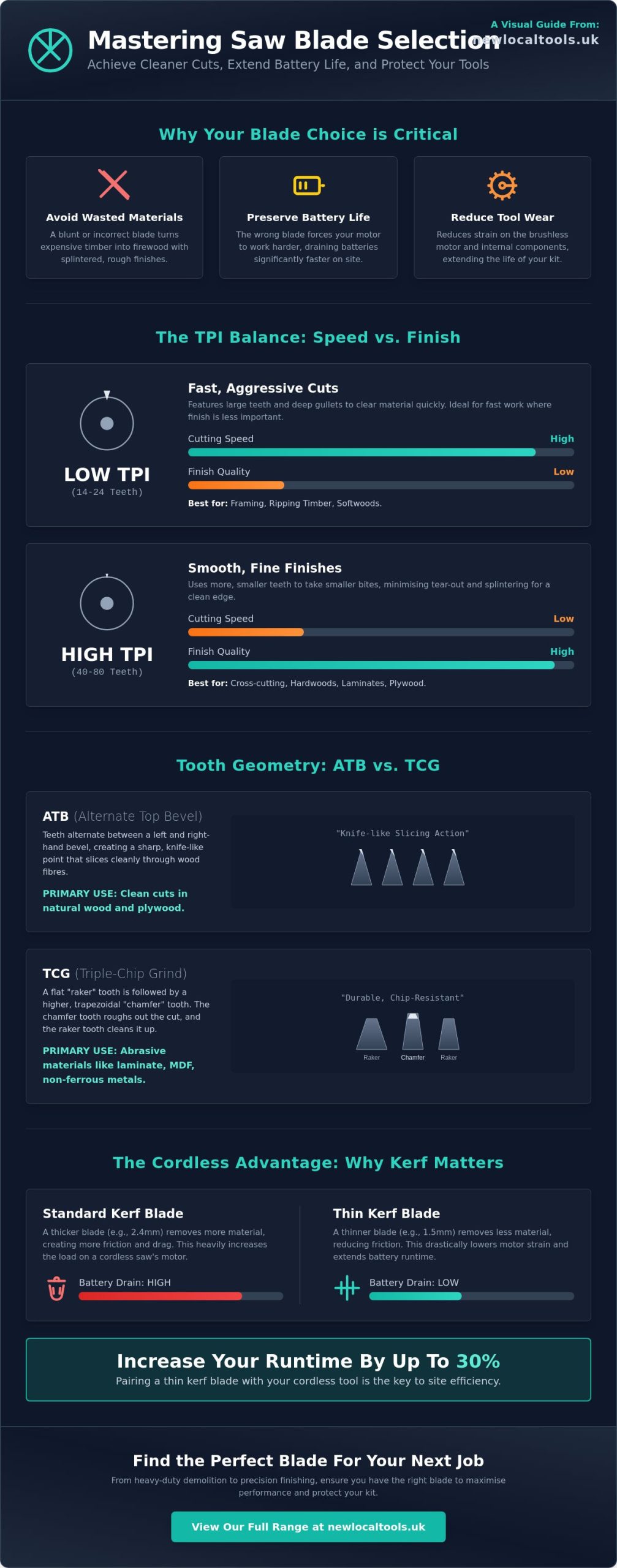
- What TPI (Teeth Per Inch) actually means for your finish: TPI is a simple measure of how many teeth are on a blade. A lower TPI results in a faster, more aggressive cut with a rougher finish, while a higher TPI gives a slower, finer cut with a cleaner finish.
- How to choose between high TPI for finish and low TPI for speed: For ripping through framing timber where speed is essential, a low TPI blade is ideal. For finishing work on skirting or architrave, a high TPI blade will prevent splintering.
- The role of tooth geometry in clearing sawdust: The space between teeth, known as the gullet, is designed to clear away waste material. Low TPI blades have large gullets to remove sawdust quickly during fast cuts, preventing the blade from binding.
- Why a tradesperson should never use a dull blade: A dull blade generates excess heat, puts immense strain on your saw’s motor, and is a major safety hazard. It forces you to push the tool harder, increasing the risk of kickback and ruining the workpiece.
TPI: Finding the Sweet Spot for Your Material
The “right” TPI is always a trade-off between speed and finish. A blade with 80 teeth might give a perfect finish on a thin piece of laminate, but it will burn and bind if used to rip through a thick, 4-metre sheet of plywood. It’s crucial to match the TPI not just to the material, but to its thickness.
- Low TPI (14–24): Best for fast, rough ripping through softwoods, framing timber, and demolition work.
- High TPI (40–80): Ideal for clean cross-cutting in hardwoods, plywood, and delicate laminate work where a flawless edge is required.
- Pro Insight: Smoke coming from the cut is a clear sign that the TPI is too high for the material’s thickness, causing excessive friction and heat.
Tooth Geometry: ATB vs. TCG Explained
The shape and angle of the blade’s teeth, known as its geometry or grind, determine how it interacts with the material. The two most common types for professional work are Alternate Top Bevel (ATB) and Triple Chip Grind (TCG).
- Alternate Top Bevel (ATB): The teeth alternate between a right- and left-hand bevel, creating a sharp, knife-like action that cleanly severs wood fibres. This is the standard for most wood-cutting blades and is excellent for reducing splintering in both cross-cuts and rip cuts.
- Triple Chip Grind (TCG): This design uses a flat-topped “raker” tooth followed by a higher “trapeze” tooth. The raker tooth makes the initial rough cut, and the trapeze tooth cleans it up. TCG blades are more durable and are the professional choice for harder materials like plastic, MDF, non-ferrous metals, and laminate flooring, as they resist chipping the hard wear layer.
Circular Saw Blades: Matching Your Blade to the Workpiece
The circular saw is a cornerstone of UK site work, but its versatility is only unlocked with the right blade. A common mistake is using a single blade for every task, which compromises finish quality and puts unnecessary strain on cordless “Body Only” tools. Understanding the difference between ripping and cross-cutting, and the impact of kerf, is essential.
Ripping vs. Cross-Cutting: Choosing the Right Attack Angle
Cutting wood requires two distinct approaches depending on whether you are working with or against the grain.
- Ripping blades (low TPI): Designed for cutting along the length of a board (with the grain). These blades feature fewer teeth and large gullets to clear out long wood fibres quickly and efficiently.
- Cross-cut blades (high TPI): Used for cutting across the wood grain. They have many more teeth to sever the fibres cleanly, preventing the “fuzzing” and splintering common with the wrong blade type.
- Pro Insight: Attempting to rip a long, thick board with a high-TPI (60+) finishing blade will generate huge amounts of heat, strain the motor, and can easily lead to tool burnout.
The Cordless Advantage: Why Kerf Matters
The “kerf” is the thickness of the cut a blade makes. For cordless circular saws, where battery life is paramount, a thin kerf blade is a game-changer.
- Thin kerf blades (1.5mm – 1.6mm): These blades remove less material with each pass, which significantly reduces friction and drag. This means the saw’s motor doesn’t have to work as hard, resulting in more cuts per battery charge.
- Pairing with “Body Only” tools: To get maximum runtime from professional cordless tools like the DeWALT DCS570, pairing them with a thin kerf blade is non-negotiable for all-day performance.
Reciprocating and Jigsaw Blades for Demolition and Detail
While circular saws handle the straight cuts, reciprocating saws and jigsaws are the specialists for demolition and intricate shapes. Their effectiveness depends entirely on selecting a blade designed for a specific material and cut type.
Reciprocating Blades: From Demolition to Pruning
A reciprocating saw is the ultimate demolition tool, capable of cutting through timber, metal, and plastic. Blade choice is critical for both performance and safety.
- For heavy demolition: Choose thick, tall blades that resist bending and buckling when cutting through nail-embedded timber.
- For metal: A bi-metal blade with a high TPI is essential for cutting pipe or conduit. Using a shorter blade (around 150mm) helps reduce vibration and “chatter” for better control.
- Carbide-tipped blades: For the toughest jobs, such as cutting through cast iron, stainless steel, or thick rebar, carbide-tipped blades offer unparalleled durability and cutting life.
Jigsaw Blades: Navigating Curves and Clean Edges
Jigsaws excel at cutting curves and detailed shapes, but achieving a clean, splinter-free finish requires a specialised blade.
- T-shank vs. U-shank: The T-shank is the modern professional standard, offering a tool-free blade change system on most saws from brands like Bosch and Makita. U-shank blades are an older fitting and are less common.
- Reverse-tooth blades: These blades cut on the downstroke instead of the upstroke. This is perfect for cutting laminated worktops from the top surface, as it prevents the decorative layer from chipping.
- Material-specific blades: Always use a blade designed for the material. “Clean for Wood” blades give a fine finish on timber, while bi-metal blades are needed for cutting sheet metal or aluminium.
Frequently Asked Questions
Can I use a wood blade to cut plastic or PVC?
While a fine-tooth wood blade can cut plastic, it may melt the material and clog the teeth. For a clean cut, it’s better to use a blade specifically designed for plastic or a TCG (Triple Chip Grind) blade, which produces less heat.
How do I know when my saw blade is too dull to use safely?
Signs of a dull blade include needing to force the saw through the material, burn marks or smoke on the wood, excessive splintering, and a rough finish. If you notice any of these, it’s time to replace the blade.
Will a 184mm blade fit a saw designed for 190mm blades?
No, you should never use a blade that is a different diameter from what the saw is designed for. Using a smaller blade reduces your depth of cut and can compromise the effectiveness of the saw’s safety guard, creating a serious hazard.
What is the difference between a thin kerf and a standard kerf blade?
A thin kerf blade is physically thinner, meaning it removes less material during a cut. This reduces strain on the saw’s motor, making it the ideal choice for cordless saws to maximise battery runtime. Standard kerf blades are more rigid and are better suited for powerful corded saws making demanding cuts.
Why does my jigsaw blade keep bending during a cut?
Blade bending is usually caused by forcing the saw forward too aggressively instead of letting the blade do the work. It can also be a sign that you are using a blade that is too thin or flexible for the material’s thickness, or that the orbital action setting is too high for the detailed cut you are attempting.




 153 Leytonstone Road, E15 1LH
 Log into your account


