
 153 Leytonstone Road, E15 1LH, London






Selecting a tool brand in 2026 is no longer just about the feel of a drill in the hand; it’s a high-stakes infrastructure investment that dictates daily profit margins for the next five years. Most tradespeople understand the frustration of a van filled with three different chargers and a dozen incompatible batteries that refuse to talk to each other. It’s a logistical nightmare that drains time and eats into the bottom line when a professional is forced to buy into a new system just to access a specific trade tool.
This guide simplifies the process of choosing a cordless platform for your trade by breaking down the latest 2026 ecosystem developments from Milwaukee , Makita , DeWalt , and Bosch. Readers will discover how to match specific battery technology to a professional workflow whilst identifying which accessories are truly essential for site work. The following sections provide the technical clarity needed to select a primary battery platform with confidence, ensuring long-term productivity and avoiding the heavy costs associated with switching brands later.
Key Takeaways
- Understand why a single battery ecosystem is the most efficient logistical choice for professional site work and reducing downtime.
- Learn the critical factors in choosing a cordless platform for your trade by comparing the power and range of leading systems like DeWalt XR and FlexVolt.
- Identify how technical specifications like Ampere-hours (Ah) and brushless motor technology directly impact tool lifespan and daily productivity.
- Discover which specific tool platforms offer the best precision for joinery or the highest torque for heavy-duty plumbing and electrical tasks.
- Maximise initial investment value by utilising professional deals and technical component sets available at the New Local Tools shop.
Table of Contents
-
The Strategic Importance of Choosing a Cordless Platform for Your Trade
-
Trade-Specific Selection: Matching Platforms to Professional Requirements
The Strategic Importance of Choosing a Cordless Platform for Your Trade
A cordless platform is a single battery ecosystem where one battery type powers an entire range of professional tools. For a tradesperson, choosing a cordless platform for your trade is a decision that impacts daily workflow for at least five years. It isn’t merely about brand preference; it’s a strategic commitment to a specific logistical infrastructure. When a professional commits to a platform like Milwaukee M18 or Makita LXT, they are investing in a system designed to work together seamlessly on a busy UK site.
The financial impact of this choice is significant. Initial entry usually requires a full kit including batteries and a charger, which carries a higher upfront cost. However, once the battery stock is established, users can transition to "naked" or body-only tool purchases. These are significantly cheaper, often saving a considerable percentage per tool. Sticking to one platform ensures that every pound spent on a battery adds value to every tool in the van, rather than fragmenting the budget across multiple incompatible systems.
The Anatomy of a Professional Battery Ecosystem
A professional ecosystem relies on the synergy between the charger, the battery pack, and the tool motor. Modern Power Tool Technology and Battery Alliances have led to advanced communication between these components. Smart batteries now use internal sensors to manage heat and prevent overloading, which significantly extends the tool’s life. Major manufacturers like DeWalt and Makita prioritise backward compatibility, ensuring that new high-capacity batteries still work with tools purchased years ago. This protects the buyer’s investment against rapid obsolescence.
Why One Platform is Usually Better Than Two
Managing multiple battery platforms creates a logistical burden that directly reduces site efficiency. Carrying two or three different charger types takes up valuable space in a small van and complicates power strip management on-site. When a team standardises on a single platform, batteries become a shared resource. A carpenter can swap a flat battery from their circular saw into a colleague’s impact driver without hesitation. This interoperability is a core reason why professionals visit the New Local Tools shop to build out a unified kit. Checking the latest deals allows tradespeople to expand their arsenal with body-only tools while maintaining a lean, efficient charging setup that minimises downtime.
Comparing the Leading Professional Cordless Ecosystems
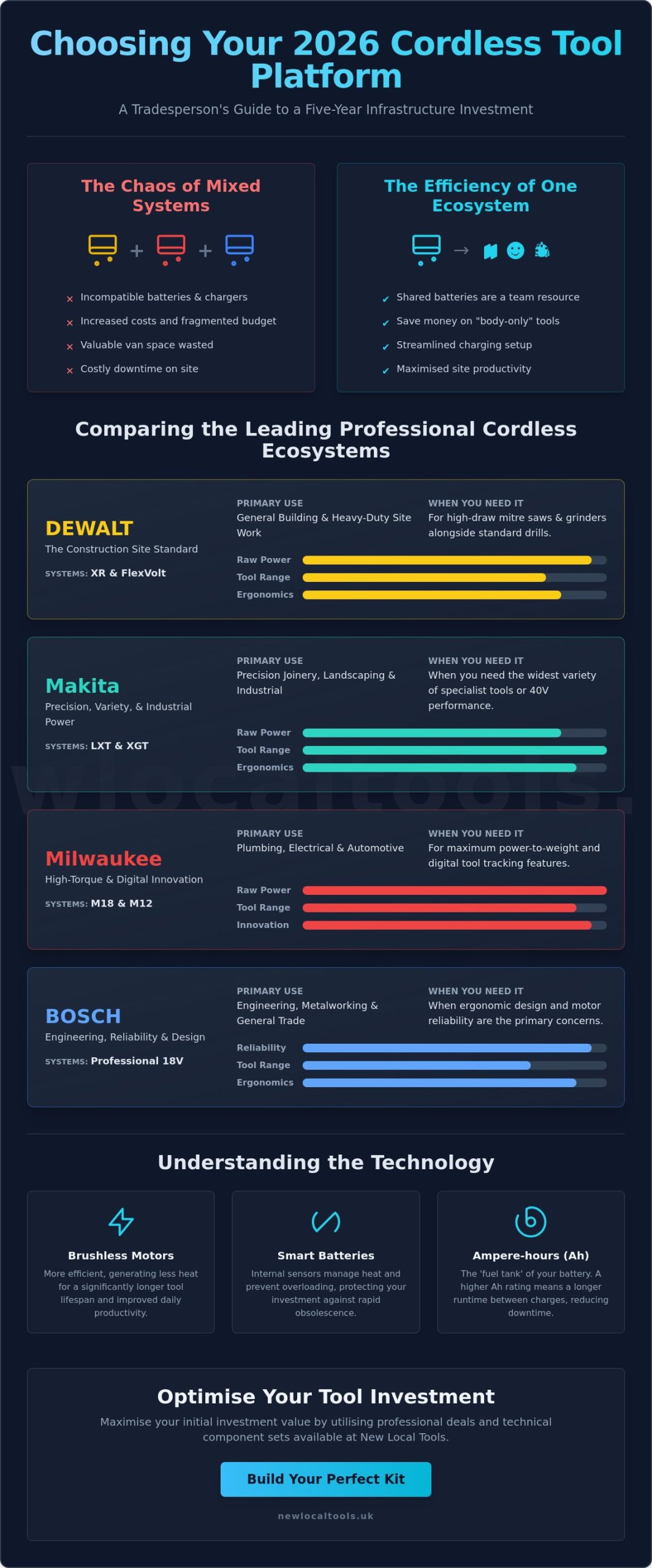
Choosing a cordless platform for your trade requires a direct comparison of the technical capabilities and tool depth offered by the industry leaders. Each brand has carved out a specific niche within the UK market, focusing on either raw power, precision, or sheer variety. For a comprehensive look at how these systems stack up against DIY alternatives, the Popular Mechanics guide to battery tool systems provides an excellent baseline for understanding professional requirements versus casual use.
| Tool Platform | Primary Use | When You Need It |
|---|---|---|
| DeWalt XR / FlexVolt | General building and heavy-duty site work | When using high-draw mitre saws or grinders alongside standard drills. |
| Makita LXT / XGT | Precision joinery, landscaping, and industrial power | When you need the widest variety of specialist tools or 40V industrial performance. |
| Milwaukee M18 / M12 | High-torque plumbing, electrical, and automotive | When maximum power-to-weight ratio and digital tool tracking are priorities. |
| Bosch Professional | Engineering, metalworking, and general trade | When ergonomic design and motor reliability are the primary concerns. |
DeWalt: The Construction Site Standard
The DeWalt XR range remains a staple on UK construction sites due to its rugged build quality and reliable performance. The FlexVolt system is a major advantage for heavy-duty users, as these 54V batteries can power massive tools like table saws whilst remaining backward compatible with standard 18V XR tools. DeWalt impact drivers and combi drills are frequently praised for their balanced ergonomics and high-speed transmission systems, making them ideal for repetitive fastening tasks in timber framing or decking. Explore the full inventory at the New Local Tools shop to compare these platforms side by side.
Makita: Precision and Specialist Breadth
With over 350 products in the 18V range, Makita LXT tools offer the most extensive selection for specialist trades. This platform is the preferred choice for joiners and landscapers who require niche equipment that other brands don’t provide. For industrial-grade power, the 40V max XGT system now includes over 170 tools designed for high-demand applications like concrete cutting and heavy demolition. Makita also leads in user comfort with its sub-compact range, which provides 18V power in a frame size typically reserved for 12V tools.
Milwaukee: The Heavy-Duty Powerhouse
Bosch Professional: Ergonomics and Reliability
The Bosch Professional (Blue) range is engineered for durability in harsh environments. Bosch has focused heavily on "EXPERT" battery technology in 2026, utilising tabless cell designs to keep tools running cooler under heavy load. Their grinders and rotary hammers are particularly well-regarded for their vibration control and safety features, such as KickBack Control, which protects the user if a bit or blade binds. This makes Bosch a strong contender for metalworkers and masonry specialists who prioritise safety and long-term tool health.
Technical Specifications: Batteries, Motors, and Efficiency
Technical specifications dictate how much work a tool can perform before it requires a trip to the charging station. When choosing a cordless platform for your trade, understanding Ampere-hours (Ah) is vital. Think of Ah as the size of a tool’s fuel tank. A 2.0Ah battery is lightweight and perfect for overhead drilling, whilst a 5.0Ah or 8.0Ah pack provides the sustained runtime needed for heavy-duty grinding or repetitive timber cutting. In 2026, the industry has shifted towards high-output pouch cell technology and tabless cells, seen in the Bosch EXPERT and Milwaukee FORGE ranges. These designs offer superior heat management and power delivery compared to traditional cylindrical cells, allowing cordless tools to match the performance of their corded predecessors.
The transition from brushed to brushless motors is now complete across all professional-grade equipment. Brushless motors use electronic controllers instead of carbon brushes to deliver power. This lack of physical friction means less heat buildup, longer tool life, and up to 50% more runtime per charge. Because there are no brushes to wear out, maintenance requirements are significantly reduced, which is a critical factor for tradespeople who cannot afford for their kit to be in the repair shop. To keep these high-performance motors running at peak efficiency, maintaining a fresh supply of accessories is essential.
| Item | Use | Notes |
|---|---|---|
| 18V 5.0Ah Li-ion Battery | General site power | The standard balance of weight and runtime for most trades. |
| Multi-Voltage Fast Charger | Battery maintenance | Reduces downtime by charging 5.0Ah packs in under 45 minutes. |
| TCT Circular Saw Blades | Timber and sheet cutting | Ensure tooth count matches the required finish (rip vs cross-cut). |
| Impact Rated Driver Bits | Heavy-duty fastening | Designed with a torsion zone to withstand high-torque impact drivers. |
Understanding Voltage and Power Delivery
The 18V system remains the de facto standard for most professional tasks. However, for high-draw applications like masonry drilling or large-scale demolition, platforms like DeWalt FlexVolt (54V) or Makita XGT (40V) are necessary. Higher voltage allows the tool to draw less current to achieve the same power output, which significantly reduces thermal stress on the battery cells. Many of these high-voltage batteries are multi-voltage compatible, meaning they can safely power standard 18V tools whilst providing a massive power boost when clicked into a dedicated high-voltage machine.
The Role of Smart Electronics in Modern Tools
Modern professional tools and batteries communicate in real-time to protect the user’s investment. Internal microchips monitor cell temperature and current draw, automatically cutting power if the tool begins to overheat or if the battery reaches a deep-discharge state that could cause permanent damage. This intelligence also allows for adjustable speed and torque settings, which is invaluable when switching between delicate cabinet assembly and heavy-duty structural bolting. Using professional chargers from the New Local Tools shop ensures that these communication protocols are followed, extending the overall lifespan of the battery packs. Tradespeople looking to expand their kit should monitor the latest deals for high-output battery bundles to maximise their site productivity.
Trade-Specific Selection: Matching Platforms to Professional Requirements
Choosing a cordless platform for your trade is a decision that should be dictated by the specialised tools required for a specific niche. A generic drill and driver set might suffice for basic tasks, but professional productivity relies on having access to high-performance, trade-specific machinery. By 2026, the major manufacturers have diversified their ecosystems to cater to distinct site roles, ensuring that every professional can find a battery system that mirrors their daily workflow.
Carpentry and Joinery: Precision Over Raw Power
Carpenters and joiners prioritise precision, finish quality, and effective dust management. Makita LXT is a dominant choice in this sector because it offers a massive depth of woodworking tools, including the cordless plunge saw and the specialised 18V 1/4 inch router. These tools are engineered for fine adjustments rather than just brute force. When selecting a platform, the professional should look for systems that offer advanced vibration control (AVT) to reduce fatigue during long sanding or cutting sessions. Using a 4.0Ah battery often provides the best balance, offering enough runtime for a cordless mitre saw whilst keeping the tool light enough for overhead work.
Dust extraction is a critical legal and health consideration on UK jobsites. The best platforms for joinery now feature Bluetooth-enabled vacuum activation, where the extractor starts automatically when the tool trigger is pulled. This level of integration is a key factor when choosing a cordless platform for your trade, as it maintains a clean workspace without the trip hazard of trailing leads.
MEP Trades: Compact Performance in Tight Spaces
Mechanical, electrical, and plumbing (MEP) professionals frequently work in confined environments like service risers, ceiling voids, or under floorboards. Milwaukee M12 and M18 FUEL systems lead this sector by providing high-torque performance in a sub-compact frame. The M12 range is particularly useful for electricians who need a lightweight impact driver or a specialised copper pipe cutter that fits between joists. For heavier tasks, such as drilling through masonry with an SDS drill, the M18 platform provides the necessary punch without the bulk of traditional corded equipment.
Lighting solutions are often overlooked but are essential for MEP trades. A battery platform that includes high-output LED site lights and headlamps allows a professional to illuminate dark work areas using the same batteries as their power tools.
General builders and groundworkers require the rugged durability found in high-voltage systems. DeWalt FlexVolt provides 54V performance for heavy-duty tasks like breaking concrete or cutting large-diameter masonry. Meanwhile, the landscaping sector has fully embraced cordless Outdoor Power Equipment (OPE). With Makita LXT now boasting over 350 compatible products, gardeners can run professional-grade chainsaws, mowers, and blowers on the same 18V batteries used for their construction tools, eliminating the need for petrol and reducing site noise levels.
Optimising the Tool Investment with New Local Tools
The final stage in choosing a cordless platform for your trade involves a calculated purchasing strategy. A professional shouldn’t simply buy tools as they appear on a shelf. Instead, they should look for a retail partner that understands the fast-paced nature of UK construction sites. New Local Tools serves as a digital evolution of the traditional local hardware store, providing a bridge between major manufacturer innovation and the practical needs of the London trade community. This approach ensures that every pound spent contributes to a leaner, more efficient workflow.
Building Your Kit: Bare Tools vs Combo Sets
For those starting a new system from scratch, a high-value combo set is the most logical entry point. These kits typically include a combi drill, an impact driver , two high-capacity batteries , and a multi-voltage charger. This bundle establishes the necessary battery stock at a lower price point than buying each component individually. Once this foundation is in place, the professional can expand their capability by purchasing "bare" or body-only tools. This strategy allows a carpenter to add a circular saw or an electrician to add a specialised SDS drill without paying for a third or fourth battery they don’t need.
The Value of a Trusted UK Partner
A professional tool investment requires more than just a transaction; it requires the security of a reliable UK-based support network. The About us page highlights a heritage built on expert-to-expert communication, ensuring that buyers receive technical advice grounded in site reality. This local expertise is backed by manufacturer warranties that provide peace of mind if a motor or battery fails under heavy use. It’s a level of accountability that international marketplaces simply cannot match.
Frequently Asked Questions
Is it better to buy a 12V or 18V cordless platform for general trade use?
18V is the industry standard for general trade use because it provides the torque needed for heavy-duty drilling and cutting. Whilst 12V systems are excellent for precision work in tight cupboards, they lack the runtime for sustained site work. Most professionals start with an 18V platform to power everything from combi drills to circular saws with one battery type. Choosing a cordless platform for your trade usually begins with this 18V foundation.
Can I use a 5.0Ah battery on a tool that originally came with a 2.0Ah battery?
High-capacity 5.0Ah batteries are fully compatible with tools originally supplied with 2.0Ah packs as long as the voltage is identical. The primary difference is the runtime; a 5.0Ah battery provides more than double the work duration per charge. However, the larger pack adds significant weight to the tool, which might affect balance during delicate tasks or prolonged overhead drilling. This compatibility allows for a flexible power strategy across a single tool kit.
What is the average lifespan of a professional lithium-ion battery in 2026?
Professional lithium-ion batteries in 2026 typically last between three and five years depending on site conditions and charging habits. Most high-tier manufacturers design their cells to withstand roughly 1,000 to 1,500 full charge cycles before a noticeable drop in capacity occurs. Using smart chargers and avoiding extreme temperatures on-site are the most effective ways to maximise this lifespan and maintain peak tool performance over several years of heavy use.
Do brushless motors really require less maintenance than brushed versions?
Brushless motors require significantly less maintenance because they eliminate the carbon brushes found in traditional motors. There are no wearable parts to replace and no carbon dust buildup inside the tool housing. This design also generates less heat during operation, which reduces the thermal stress on internal components. This leads to a much longer overall tool life and higher reliability compared to brushed alternatives, making them the superior choice for daily site work.
How many batteries should a professional tradesperson typically own for one platform?
A professional tradesperson should typically own at least three batteries for their primary platform to ensure continuous operation. This "one in the tool, one on charge, one ready" rotation eliminates downtime during intensive tasks. When choosing a cordless platform for your trade, investing in a mix of lightweight 2.0Ah packs for drills and high-output 5.0Ah or 8.0Ah packs for high-draw machinery like grinders is the most efficient logistical strategy for a busy van.



 153 Leytonstone Road, E15 1LH
 Log into your account


