
 153 Leytonstone Road, E15 1LH, London






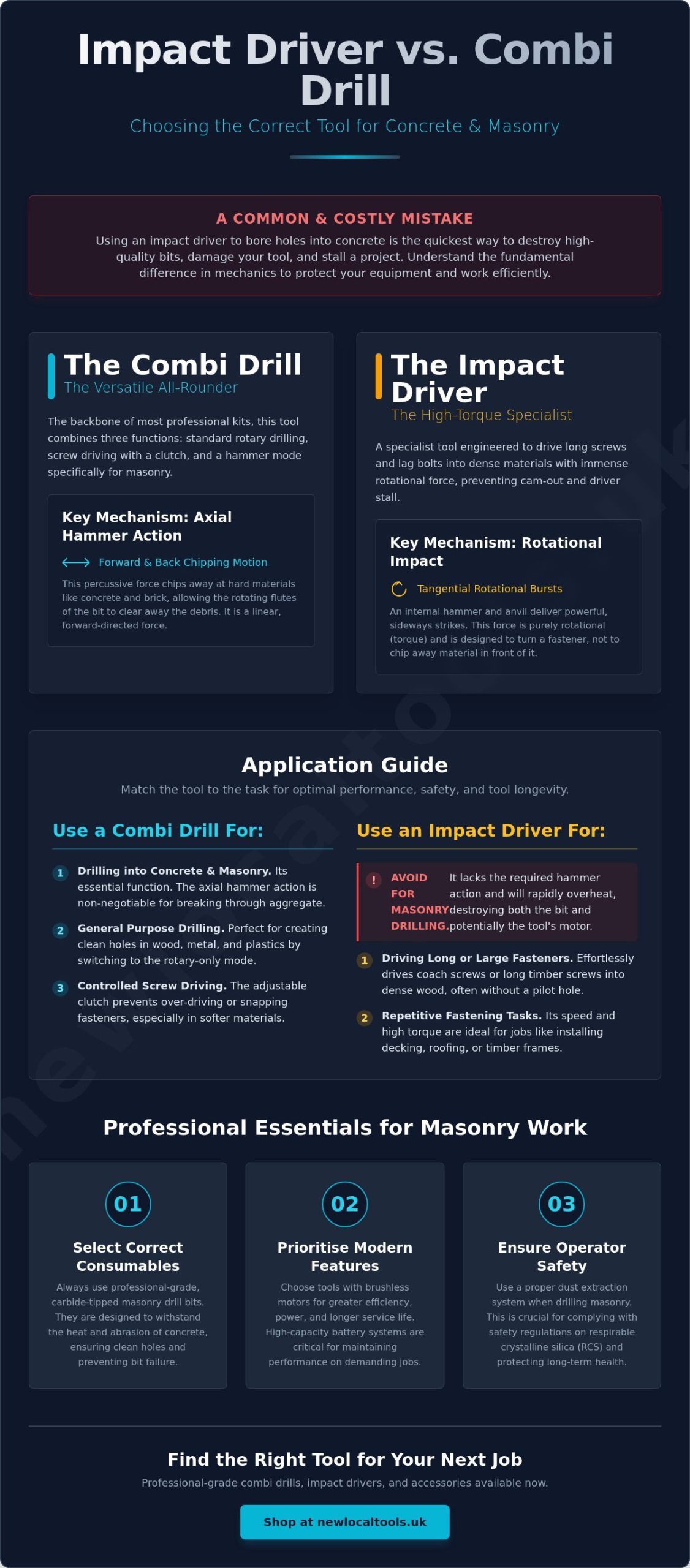
Reaching for an impact driver to bore holes in masonry is often the quickest way to ruin a high-quality bit and stall a professional project. While the name suggests power, the internal mechanics of an impact driver vs combi drill for concrete tell a very different story for site performance. Most tradespeople have experienced the frustration of a burnt-out drill bit or a smoking motor when facing a stubborn concrete slab. It’s a common site error that costs time and money, yet it’s easily avoided with the right technical knowledge and the correct hardware from New Local Tools .
This guide provides a definitive technical comparison to help users choose the correct power tool for masonry applications whilst avoiding expensive equipment damage. It delivers a clear breakdown of when to deploy rotational torque and when to rely on axial hammer action. Readers will gain a full understanding of tool limitations, professional-grade hardware selection, and the latest safety regulations regarding respirable crystalline silica. From understanding the 50 microgram exposure limits to selecting the right consumables, this article ensures successful drilling and fixing every time.
Key Takeaways
- The fundamental difference between axial hammer action and rotational torque dictates which tool is suitable for drilling versus driving fasteners.
- Determining the correct application for an impact driver vs combi drill for concrete ensures maximum efficiency and prevents premature motor failure.
- Selecting professional carbide-tipped consumables prevents bit failure and ensures clean, accurate holes whilst working in dense masonry.
- Technical specifications such as brushless motor technology and high-capacity battery configurations are critical for maintaining professional-grade performance.
- Implementing proper dust extraction systems ensures compliance with current safety regulations regarding respirable crystalline silica.
Table of Contents
Understanding the Concrete Challenge: Tool Definitions
Concrete isn’t like timber or plastic. It’s an abrasive, high-density material that demands specific mechanical intervention to penetrate. For many UK tradespeople, the decision between an impact driver vs combi drill for concrete determines whether a task takes minutes or ends in a trip to the skip with a burnt-out motor. Concrete consists of hard aggregate bound by cement, creating a surface that resists simple rotation. Without a percussive element, a drill bit will simply spin and generate heat, leading to bit failure or "glazing" of the hole. Understanding these tool definitions is the first step in protecting your investment in professional cordless power tools .
A combi drill serves as a jack-of-all-trades, offering a dedicated hammer setting specifically for masonry. In contrast, an impact driver is a specialist engineered for high-torque fastening. The debate of impact driver vs combi drill for concrete often centres on the type of force applied. Whilst both tools spin, they handle resistance in fundamentally different ways. One uses a linear chipping motion, whereas the other relies on rotational bursts to turn a fastener.
The Combi Drill: A Versatile Tradesman Favourite
The combi drill is the backbone of most professional kits because it combines three tools in one. It features distinct modes for rotary drilling in wood and metal, a screwdriver mode with an adjustable clutch, and a hammer mode for masonry. When you switch to hammer mode, the drill engages two ribbed discs that click against each other. This creates a rapid vibration that chips away at the concrete substrate whilst the bit rotates to clear debris. Most professional models come with a 13mm keyless chuck, allowing them to accept a wide variety of round and hex-shank bits. The adjustable clutch system is a vital secondary feature, giving the user precise control over torque to prevent over-driving or snapping screws in softer materials.
The Impact Driver: Precision and Power for Fasteners
An impact driver isn’t a drill in the traditional sense; it’s a high-torque specialist designed to drive long screws and bolts into dense materials. The internal Impact driver mechanism uses a spring, hammer, and anvil to deliver sudden, powerful bursts of rotational force. This tangential impact is what allows it to drive fasteners that would stall a standard drill. These tools use a standardised 1/4 inch hex drive system rather than a traditional chuck, making them incredibly compact. This short head design is perfect for tight spaces where a bulky combi drill won’t fit. It’s important to remember that this tool is designed for driving, not boring holes into stone or concrete. It lacks the forward-and-back axial motion required to break through aggregate effectively.
Hammer Action vs Rotational Impact: The Physics of Concrete
To understand the debate of impact driver vs combi drill for concrete, one must look at the mechanical direction of force. Concrete requires a "chip and clear" approach. A combi drill provides axial force, which is a percussive forward-and-back motion that physically breaks the aggregate in front of the bit. In contrast, an impact driver delivers rotational torque, often described as tangential force. This is a sideways strike that pushes a fastener around its axis. Whilst this is perfect for driving screws, it does nothing to penetrate the hard face of a masonry substrate.
The technical metrics for these forces are often confused on site. Combi drills are measured in Blows Per Minute (BPM), representing the number of times the internal discs strike to create that linear hammering. Impact drivers are measured in Impacts Per Minute (IPM), which refers to how many times the internal hammer strikes the anvil to increase turning force. Using rotational impact to drill into masonry is a recipe for disaster. The lack of forward percussion means the bit creates immense friction without progress. This heat buildup can cause the tungsten carbide tip of a masonry bit to desolder or even snap the shank entirely.
Professional users should recognise that these tools are engineered for different stresses. A combi drill is built to handle the constant vibration of axial strikes. An impact driver is built to handle the sudden, high-torque snaps of rotational impacts. Mixing these applications leads to "glazing" the concrete surface, where the material becomes polished and even harder to penetrate, ultimately destroying your consumables.
How the Combi Drill Tackles Masonry
A combi drill uses two floating discs with ridged surfaces. As the motor turns, these ridges climb over each other, forcing the chuck forward before a spring snaps it back. This creates the rapid hammering action necessary for masonry work. This vibration also helps clear dust from the flutes of the bit, preventing the hole from clogging. However, even the best combi drills have limits. In high-density or reinforced concrete containing rebar, the mechanical hammer action often lacks the joule energy required. For these heavy-duty tasks, professionals usually step up to an SDS+ rotary hammer , which uses a pneumatic piston rather than simple discs.
Why Impact Drivers Struggle with Concrete Holes
An impact driver lacks any axial movement. When the bit hits the resistance of concrete, the tool simply engages its internal hammer to provide more turning force. Without the "chipping" motion, the bit just grinds against the stone. This creates extreme heat which ruins impact driver vs combi drill for concrete comparisons when hole-boring is the goal. The only time an impact driver should touch concrete is when driving specialised masonry screws into a pre-drilled hole. For those looking to upgrade their kit, exploring high-torque options at newlocaltools.uk/shop/ ensures you have the right tool for the specific job at hand.
Direct Comparison: When to Use Which Tool
Selecting the correct tool for site work depends entirely on the stage of the installation. For most professional applications, the impact driver vs combi drill for concrete debate isn’t about which tool is better, but which tool is appropriate for the current task. A two-tool strategy is the standard for efficiency. High-performance DeWalt professional tools are frequently supplied in twin packs to ensure tradespeople have both percussive drilling and high-torque driving capabilities on hand.
| Tool | Primary Use | When You Need It |
|---|---|---|
| Combi Drill | Drilling holes in masonry and brick | Boring pilot holes for plugs and anchors |
| Impact Driver | Driving heavy-duty fasteners | Securing concrete screws and Tapcons |
Speed and power serve different masters in masonry work. The combi drill prioritises speed through high Blows Per Minute (BPM) to pulverise aggregate. The impact driver prioritises power through rotational torque to seat fasteners. Electricians often rely on this combination for mounting metal consumer units or trunking. Joiners require the specific torque of an impact driver to pull timber battens flush against uneven brickwork once the pilot holes are prepared.
Drilling the Pilot Hole: The Combi Drill Advantage
The combi drill is the only choice for the first phase of any masonry fixing. Its hammer mode provides the necessary axial force to penetrate standard brick and blockwork. For small diameter holes, typically 5mm to 8mm, a high RPM setting between 1,500 and 2,000 is recommended to maintain progress. However, there is a clear ceiling to its capability. If the project involves drilling holes larger than 12mm or requires penetration into high-density reinforced concrete, it is time to transition from a combi drill to a dedicated SDS plus rotary hammer .
Fixing the Fastener: The Impact Driver Advantage
Once the hole is bored, the impact driver becomes the superior tool for the fixing stage. When driving specialised concrete screws like Tapcons, the rotational impact mechanism provides the necessary "kick" to overcome the massive friction of the substrate. This mechanism prevents cam-out, where the bit slips and damages the screw head. It also significantly reduces wrist strain for the user, as the tool does the work of applying torque. This makes the impact driver indispensable for high-volume fixing tasks where a standard drill would likely stall or overheat.
Essential Accessories for Concrete and Masonry Work
Even the most powerful motor is useless without the correct consumable at the point of contact. Standard high-speed steel (HSS) bits fail almost instantly in concrete because they lack the hardness to resist the abrasive nature of aggregate. High temperatures generated during the "chip and clear" process will dull a standard bit within seconds. Choosing the right accessories is just as critical as the impact driver** vs combi drill for concrete** decision itself. For professional results, users must match the bit technology to the tool’s mechanical action.
Impact-rated accessories are specifically engineered to withstand the concussive forces of modern cordless tools . Whilst a standard screwdriver bit might shatter under the tangential stress of an impact driver, an impact-rated bit features a "torsion zone" that flexes to absorb the peak torque. Using non-rated bits in a high-torque environment is a safety risk and leads to frequent site delays. Maintaining a stocked kit of professional Power Tool Accessories ensures that work continues without unnecessary trips to the merchant.
| Item | Use | Notes |
|---|---|---|
| Carbide-Tipped Masonry Bits | Drilling into brick, block, and concrete | Requires hammer mode; use straight or hex shanks |
| Impact-Rated Screwdriver Bits | Driving fasteners into pre-drilled holes | Essential for impact drivers to prevent bit breakage |
| Multi-Construction Bits | Drilling through timber into masonry | Versatile for installers; avoids bit changes |
| Concrete Screws (Tapcons) | Direct fixing into masonry substrate | Eliminates the need for plastic wall plugs |
Masonry Bits and Multi-Construction Options
High-performance masonry bits feature a brazed tungsten carbide tip that provides the hardness required to pulverise stone. For many UK tradespeople, multi-construction bits have become a preferred choice. These bits are sharpened to cut through timber or plastic whilst retaining the durability to handle the masonry behind it. This is particularly useful for window fitters or joiners fixing battens. When selecting bits, ensure the shank matches the tool. Combi drills typically use a straight or hex shank in a 13mm chuck, whereas impact driver require a 1/4 inch hex fitment for their quick-release collets.
Concrete Fixings and Fasteners
Selecting the Right Kit: Professional Features to Look For
When evaluating an impact driver** vs combi drill for concrete**, the internal specifications are just as important as the tool type. Brushless motor technology is now the industry standard for professional masonry work. These motors lack the physical brushes found in older designs, meaning they generate less friction and heat. This is vital when drilling into concrete, where the tool is under constant high load. A brushless motor provides up to 50% longer runtime and significantly more power, ensuring the tool doesn’t stall whilst boring into dense aggregate.
Battery capacity is another critical factor for site performance. For hammer modes and high-torque driving, a battery rated at 5.0Ah or higher is recommended. High-draw applications like masonry drilling can quickly deplete smaller 2.0Ah cells, leading to voltage drop and reduced percussive force. Many Milwaukee Fuel models are engineered to optimise this power delivery, maintaining consistent BPM even as the battery level fluctuates. Choosing a high-capacity platform ensures the tool has the "grunt" required for a full day of fixing.
User safety should never be an afterthought. High-torque combi drills can produce significant "kickback" if a drill bit binds on rebar or a hard flint. Look for tools equipped with side handles and electronic clutch systems that instantly cut power when a sudden rotation is detected. Ergonomic vibration control is also essential for long-term health, reducing the risk of Hand-Arm Vibration Syndrome (HAVS) during prolonged drilling. Brands like Makita lead the way with their AVT (Anti-Vibration Technology), making them a favourite amongst UK contractors.
Torque Ratings and Speed Settings
Torque is measured in Newton Metres (Nm), and it determines the tool’s ability to overcome resistance. Whilst a [combi drill](combi drill) needs high Nm for large masonry bits, an impact driver requires it to seat concrete screws. Most professional units offer multiple speed gears. A lower gear provides the high torque needed for dense concrete, whereas a higher gear provides the speed for lighter brickwork. Electronic clutches, common in premium kits, allow for precise control, ensuring you don’t over-drive fasteners and strip the substrate.
Durability and Build Quality
Site environments are unforgiving, and concrete dust is a known "killer" of power tools. Professional-grade hardware features all-metal gearbox construction to withstand the heat and stress of hammer action. Sealed electronics and protected trigger assemblies are also vital to prevent fine silica dust from causing short circuits. When investing in a new kit, purchasing from a trusted UK retailer ensures you receive a full manufacturer warranty, providing peace of mind for your business. Understanding how these build quality factors influence the impact driver** vs combi drill for concrete** decision will help you build a more resilient tool inventory.
Mastering Masonry Installations
Success on site depends on matching the mechanical action to the material. Whilst the impact driver** vs combi drill for concrete** debate often confuses beginners, the technical reality is clear. Use the combi drill’s axial hammer action for boring accurate pilot holes and reserve the impact driver’s rotational torque for seating heavy-duty fasteners. This two-tool strategy protects your equipment from overheating and ensures every fixing holds firm in dense substrates. Investing in high-performance brushless technology from industry leaders like DeWalt, Makita, and Milwaukee provides the durability required for demanding UK site conditions.
Frequently Asked Questions
Why does a combi drill produce a burning smell during masonry work?
A burning smell typically indicates excessive heat buildup caused by a blunt bit or insufficient cooling intervals. When the cutting edge of a masonry bit loses its sharpness, the motor must work harder to overcome friction, leading to scorched internal windings. Maintaining sharp carbide tips and allowing the tool to run at high speed without load between holes helps to dissipate this heat and protect the motor.
How is the snapping of masonry screws prevented when using high-torque tools?
Fastener failure occurs when rotational torque exceeds the screw’s shear strength, often due to a pilot hole that is too narrow or clogged with debris. To prevent this, the pilot hole must be drilled at least 10mm deeper than the screw length. This provides a necessary reservoir for dust, ensuring the tool can seat the fastener without meeting the terminal resistance that leads to snapping.
What RPM settings are appropriate for drilling into aged British brickwork?
Aged brickwork is often brittle and requires a lower RPM setting to prevent the substrate from shattering. Setting a combi drill to a lower speed gear, typically between 400 and 600 RPM, provides more controlled percussion. This reduces the risk of the brick face blowing out and ensures the hole remains the correct diameter for a secure, long-term fixing.
When is the torque of an impact driver vs combi drill for concrete most likely to cause material failure?
Material failure is most common when the specific mechanical strengths of the impact driver** vs combi drill for concrete** are misapplied. Using the rotational impact of a driver to bore holes leads to glazed concrete and destroyed bits. Conversely, using a combi drill to drive heavy-duty anchors without an impact mechanism often results in cam-out and damaged screw heads. Matching the tool to the specific phase of the installation is essential for site safety.



 153 Leytonstone Road, E15 1LH
 Log into your account


