
 153 Leytonstone Road, E15 1LH, London






Would a standard plastic handle provide enough protection against a 1,000-volt surge? Professionals know that a simple mistake on a live circuit can be fatal. For those asking what are VDE screwdrivers, these are precision-engineered tools tested to withstand 10,000 volts to ensure safety in high-stakes environments.
This guide clarifies the jargon surrounding VDE certification, explains how to identify professional-grade equipment, and breaks down the BS EN IEC 60900 standards that govern every insulated hand tool sold in the UK.
Key Takeaways
- Understand exactly what are VDE screwdrivers and why the Verband der Elektrotechnik certification is the essential safety benchmark for UK electrical work.
- Learn about the intensive 10,000V “Voltage Soak Test” that guarantees a 10:1 safety margin for tools rated for 1,000V AC live working.
- Discover the benefits of SlimLine insulation technology, which allows for easier access to recessed screws without compromising the protective barrier.
- Identify the critical signs of insulation wear and learn the professional standards for maintaining tool integrity to ensure long-term site safety.
- Determine whether a comprehensive set or individual drivers best suit specific domestic or commercial tasks whilst ensuring full compliance with BS EN IEC 60900.
Table of Contents
- What are VDE Screwdrivers? Defining the Standard for Electrical Safety
- VDE vs Standard Screwdrivers: Why Insulation Matters
- The Rigorous Testing Behind the VDE Mark: 10,000V and Beyond
- Choosing and Maintaining VDE Screwdrivers for Longevity
What are VDE Screwdrivers? Defining the Standard for Electrical Safety
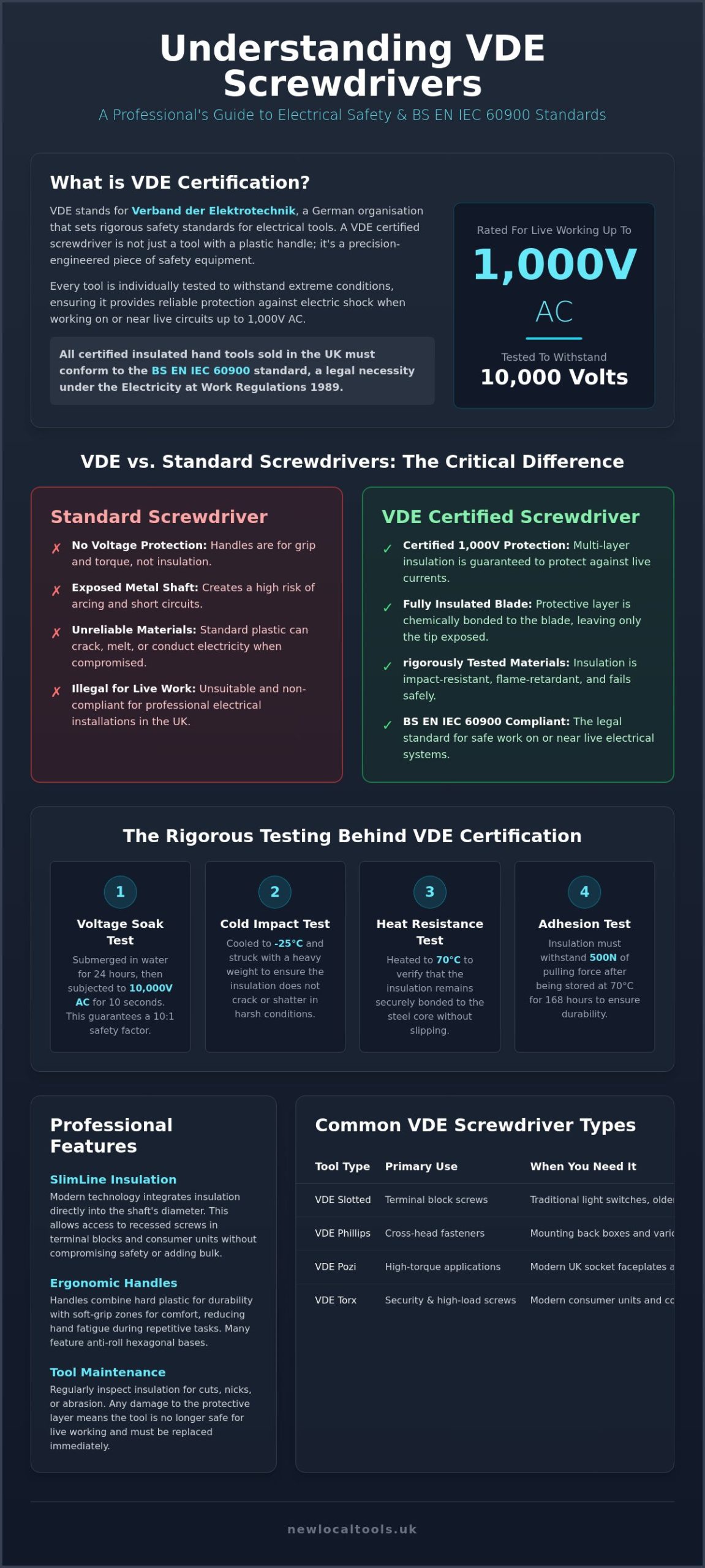
VDE stands for Verband der Elektrotechnik, which is the German-based VDE (the Association for Electrical, Electronic & Information Technologies). This organisation tests and certifies electrical equipment to strict safety requirements. VDE screwdrivers are not standard tools with a simple plastic coating. Both the handle and the majority of the blade are encased in a protective, non-conductive insulation layer tested to 10,000V.
Every certified tool carries a clear “1,000V AC” rating — the industry standard for safe use on live equipment. The certification process tests insulation at 10,000V to provide a significant safety margin against voltage spikes and harsh site conditions. In the UK market, these tools are recognisable by their distinct red and yellow colour scheme and the double triangle symbol.
Answering what are VDE screwdrivers also requires understanding BS EN IEC 60900 — the international benchmark governing the design and production of every insulated hand tool sold in the UK. Using properly insulated tools is a legal necessity under the Electricity at Work Regulations 1989 (EAWR). Regulation 14 mandates that no person shall work near any live conductor unless suitable precautions are taken.
Why “Regular” Screwdrivers are Not Sufficient
Standard handles are designed for ergonomics and grip — not for stopping high-voltage current. Regular tools often leave a large portion of the metal shaft exposed, creating a risk of arcing where electricity jumps from a live terminal to the tool. VDE insulation is chemically bonded to the blade to prevent this — a technique relying on high-performance industrial adhesives from specialists like bondrite.co.uk — and is tested for flame retardancy and impact resistance to ensure the protective barrier remains intact even if the tool is dropped or exposed to heat.
VDE vs Standard Screwdrivers: Why Insulation Matters
Standard drivers rely on a bare steel shaft. VDE variants feature insulation covering the entire blade — leaving only the tip exposed. This prevents the shaft from making contact with adjacent live components or grounded metalwork, eliminating the risk of short circuits.
Modern SlimLine technology, found in ranges from Stanley and Milwaukee, solves a common complaint about older insulated tools. Older designs had bulky shafts that couldn’t reach recessed screws in terminal blocks. SlimLine blades integrate the insulation into the diameter of the shaft — same protection without the added bulk.
The VDE Testing and Certification Institute ensures these tools are designed to fail safely. If a VDE screwdriver is subjected to extreme heat or mechanical stress, the insulation is engineered to char or melt in a way that remains non-conductive for as long as possible. This is a stark contrast to general-purpose screwdrivers, where the plastic might simply ignite or conduct current once the surface is compromised. For those building a professional kit, choosing certified hand tools ensures that every component is built for the rigours of electrical work.
VDE Tool Comparison Framework
When selecting the right equipment, it is important to understand **what are VDE **screwdrivers in the context of specific drive types. The following table outlines the most common variants used in the UK market.
| Tool | Primary Use | When You Need It |
|---|---|---|
| VDE Slotted | Tightening terminal block screws and small connectors. | Essential for traditional light switches and older consumer units. |
| VDE Phillips | General purpose cross-head fasteners. | Used for mounting back boxes and securing specific electrical components. |
| VDE Pozi | High-torque applications with Pozidriv screws. | The standard choice for modern UK socket faceplates and ceiling roses. |
| VDE Torx | Specialised star-shaped security and high-load screws. | Increasingly common in modern consumer units and industrial control panels. |
The Ergonomics of Professional VDE Tools
Professional-grade handles combine hard plastics for strength with soft-grip zones for comfort, reducing hand fatigue during repetitive tasks such as wiring a full consumer unit. Most include anti-roll features — hexagonal handle bases prevent the tool from rolling off a ladder or high surface.
The Rigorous Testing Behind the VDE Mark: 10,000V and Beyond
The most critical part of VDE certification is the Voltage Soak Test. Every tool is submerged in water for 24 hours, then blasted with 10,000V AC for 10 seconds. This creates a 10:1 safety factor over the 1,000V rating.
Certified tools must also survive the Cold Impact Test — cooled to -25°C and struck with a heavy weight to verify the insulation doesn’t crack or flake. A Heat Resistance Test ensures insulation remains bonded to the steel core at 70°C, preventing handle slip near heavily loaded circuits.
Understanding the IEC 60900 Standard
When looking at the handle of a professional screwdriver, the double triangle symbol signifies the tool is officially rated for 1,000V AC and 1,500V DC. Every single VDE screwdriver is individually tested at 10,000V before leaving the factory — safety is guaranteed per item, not per batch.
The adhesion between insulation and steel core is tested to withstand 500N of pulling force after storage at 70°C for 168 hours. In the combustion test, insulation is exposed to a flame for 10 seconds and must be self-extinguishing — it cannot continue to glow or burn once the flame is removed.
Choosing and Maintaining VDE Screwdrivers for Longevity
For most UK domestic tasks, a 6-piece or 7-piece screwdriver set containing Slotted and Pozi drivers is the standard starting point. Professional electricians often prefer interchangeable blade systems — saving bag space whilst providing a wider variety of drive types.
| Item | Use | Notes |
|---|---|---|
| VDE Interchangeable Blades | Swapping drive heads on a single insulated handle. | Inspect the locking mechanism weekly for mechanical wear. |
| Voltage Testers | Secondary verification that a circuit is dead before contact. | Replace batteries annually to ensure accurate readings. |
| Insulating Tape | Temporary colour-coding or marking of cables. | Ensure tape meets BS EN 60454-3-1 standards for site use. |
| Tool Cleaning Wipes | Removing grease and grit from insulated handles. | Avoid solvent-based cleaners that can degrade the insulation material. |
Safety Inspection: When to Replace Your Tools
Perform a visual inspection before every use — look for nicks, deep scratches, or discolouration in the red and yellow coating. If the inner insulation layer becomes visible through a surface cut, the tool is compromised and must be retired immediately. A damaged VDE screwdriver must never be used as a regular tool — once the insulation is breached, the 1,000V barrier no longer exists.
Never use a VDE screwdriver as a pry bar or chisel. Lateral force causes the insulation to delaminate from the steel core, creating hidden air gaps where electricity can arc. Dirt, moisture, and metallic dust can form a conductive bridge across the insulation surface — regular cleaning ensures the tool performs to its certified rating.
Screwdrivers at New Local Tools
New Local Tools stocks a professional range of screwdrivers and screwdriver sets — from VDE-certified insulated tools for electrical work to general-purpose sets for site and domestic use.
For VDE insulated sets: the Stanley STA060033 VDE Screwdriver Set — 7 Piece is a reliable all-round choice for UK electricians — Slotted and Pozi drivers with SlimLine insulation. The Blue Spot 12061 Interchangeable VDE Screwdriver Set — 8pc offers an interchangeable blade system for electricians who need versatility without carrying multiple handles.
For professional sets: the Milwaukee 4932479005 Tri-Lobe VDE Screwdriver Set — 12 piece brings Milwaukee’s Tri-Lobe handle — engineered for maximum torque transfer in tight terminal blocks. The Wera 05051813001 PZ2 x 100mm VDE Kraftform Screwdriver is the benchmark individual driver for Pozidriv applications — Wera’s Kraftform handle reduces hand fatigue during extended wiring sessions.
For general-purpose sets: the Stanley STA062151 Cushion Grip Screwdriver Set — 6 Pieces covers everyday site and domestic fastening tasks. The DeWalt DHTD68001 Max Fit Multi-Bit Screwdriver Set — 10 Piece provides a versatile multi-bit option for mixed trade work.
Browse all screwdrivers at New Local Tools →
Equip Your Kit with Professional Protection
Understanding what are VDE screwdrivers is the first step toward a safer workspace. These tools provide a verified barrier against electrical hazards, ensuring compliance with the latest UK wiring regulations under BS 7671:2018+A4:2026. Selecting equipment tested to 10,000V gives the peace of mind that your kit can handle live working conditions.
New Local Tools stocks genuine certified VDE screwdrivers from Stanley, Milwaukee, Wera, and Blue Spot with free UK delivery on orders over £100.
Browse all screwdrivers at New Local Tools →
Frequently Asked Questions
Can VDE screwdrivers be used for non-electrical tasks?
How is a VDE screwdriver’s safety verified?
Safety is verified through a detailed visual inspection before every task. Professionals look for nicks, deep scratches, or discolouration in the insulation. If the inner layer of insulation becomes visible through the outer coating, the tool is no longer safe for live work. Any damage to the tip or a loose handle also indicates that the tool should be retired from service immediately to prevent accidents.
What distinguishes VDE from standard 1000V rated tools?
The primary difference lies in the certification process. While “1000V rated” suggests compliance with IEC 60900 standards, the VDE mark signifies independent testing by the Verband der Elektrotechnik. This third-party verification provides an extra layer of assurance for UK tradespeople. When asking what are VDE screwdrivers in a professional context, the focus is on this rigorous, independent testing rather than a manufacturer’s self-declaration.
Do insulated screwdrivers have a specific shelf life?
Insulated tools do not have a fixed expiry date or shelf life. Their longevity depends on usage frequency and storage conditions. Tools kept in clean, dry environments away from sharp objects can remain safe for many years. However, the Electricity at Work Regulations 1989 require that all equipment be maintained in a safe condition, making regular inspections far more important than the chronological age of the tool.
Are all red and yellow handled tools VDE certified?
Colour schemes are not a reliable indicator of certification. Many non-insulated tools use red and yellow handles to imitate the appearance of safety equipment. To confirm what are VDE screwdrivers, one must look for the official “double triangle” symbol and the 1,000V rating marked on the handle. Without these specific markings, the tool cannot be trusted for work on live electrical circuits, regardless of its colour.




 153 Leytonstone Road, E15 1LH
 Log into your account


