
 153 Leytonstone Road, E15 1LH, London






Could a lighter hammer actually deliver more striking force than a heavy one? Many site professionals across the UK suffer from persistent elbow and wrist fatigue because they believe a heavier head is always better for driving 90mm nails into C16 or C24 timber. Understanding what size hammer for framing is required involves balancing kinetic energy with swing velocity — not just relying on raw mass.
This guide explains how to identify the correct weight-to-length ratio for specific trade needs whilst protecting physical health. It covers the technical differences between milled and smooth faces, handle materials, and how to select a tool that maximises efficiency on every strike.
Key Takeaways
- Learn exactly what size hammer for framing is required for structural timber work to ensure maximum driving force without risking repetitive strain injuries.
- Understand the relationship between head mass and swing velocity to achieve consistent nail driving in standard UK C16 and C24 timber.
- Discover why handle lengths of up to 18 inches are essential for generating torque and how specific materials damp vibration to protect joints.
- Identify the performance benefits of forged steel over cast alternatives to guarantee tool longevity on demanding construction sites.
- Master the process of evaluating “swing-weight” in-store to select a hammer that balances physical comfort with professional performance.
Table of Contents
- Understanding the Framing Hammer: More Than Just a Heavy Tool
- Choosing the Right Weight: Head Mass and Swing Velocity
- Handle Length and Materials: Achieving Maximum Leverage
- Framing Hammer Comparison and Essential Accessories
- How to Select Your Framing Hammer at New Local Tools
Understanding the Framing Hammer: More Than Just a Heavy Tool
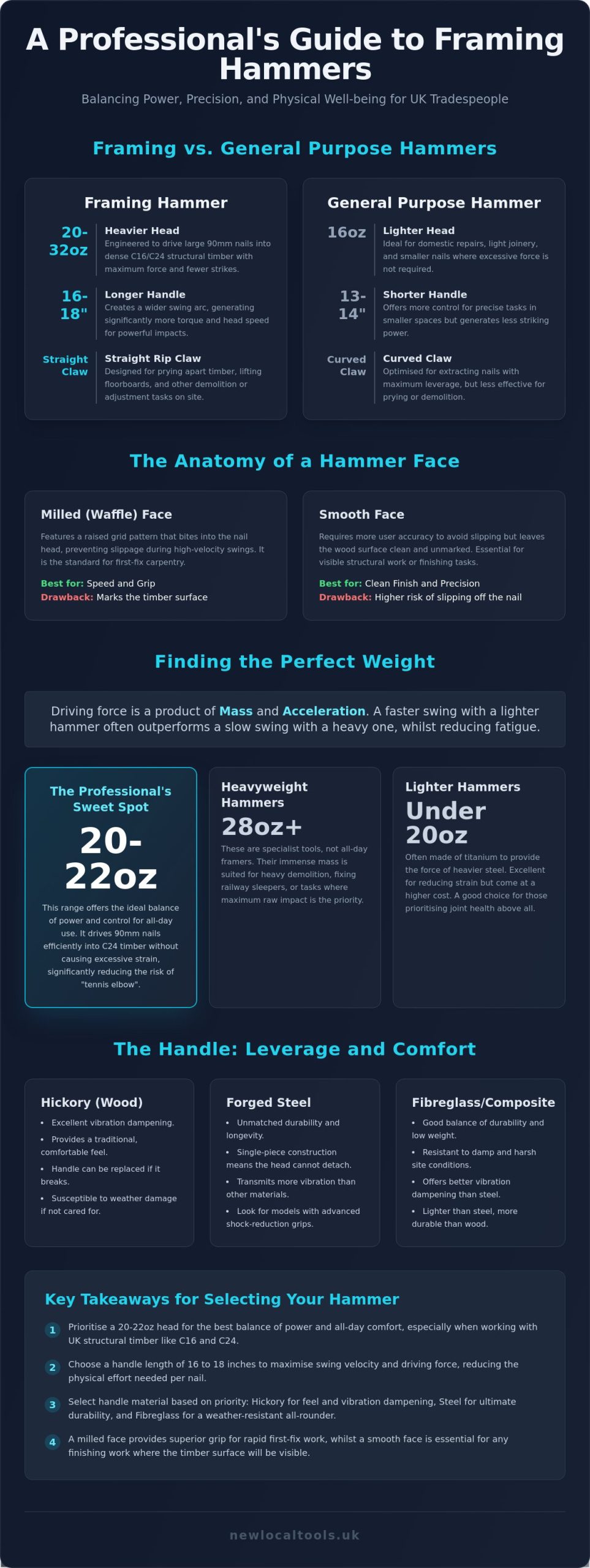
Professional framing requires more than just a standard hammer. A dedicated Framing hammer is engineered for the heavy-duty demands of structural timber work. Whilst a standard 16oz claw hammer serves well for domestic repairs or light joinery, it lacks the kinetic energy required for site work. When working with dense UK timber like C16 or C24, a standard weight often results in the head bouncing off the nail. This leads to wasted effort and increased risk of joint injury. Deciding what size hammer for framing is the first step toward professional efficiency and long-term physical health.
The framing hammer is defined by two primary characteristics: a longer handle and a heavier head. These features work together to drive large 90mm nails with fewer strikes. These tools are essential for UK construction projects involving stud walls, floor joists, and roof trusses where speed and structural integrity are paramount. Professional-grade options are available in the hand tools selection at the shop.
Framing Hammers vs. General Purpose Claw Hammers
Most standard hammers feature a 13 to 14-inch handle. Framing models extend this to 16 or 18 inches, creating a longer arc and generating massive torque for driving large fasteners. Head weight jumps from the standard 16oz to a range of 20oz to 32oz. The claw also differs — general hammers use a curved claw for pulling nails, whilst framers use a straight rip claw designed for prying apart heavy timbers or lifting floorboards.
The Anatomy of a Framer: Milled vs. Smooth Face
Milled faces feature a raised grid pattern that bites into the nail head, preventing slipping during high-velocity swings. This is the standard choice for first-fix carpentry where speed is vital. However, it leaves a distinct mark on the timber. A smooth face requires more accuracy but leaves the surface clean — better for visible structural elements or softer materials.
Choosing the Right Weight: Head Mass and Swing Velocity
The force delivered to a nail is the product of mass and acceleration. A tradesperson swinging a 20oz hammer at high velocity often generates more driving power than a slower swing with a 28oz model. The goal is to find a weight that allows a consistent, controlled swing throughout a ten-hour shift.
A simple field test: hold the hammer at the very end of the handle with the arm fully extended horizontally. If the wrist cannot hold it steady for ten seconds, the mass is likely too high for safe daily use. Following principles of Ergonomic Hand Tool Selection ensures that the chosen weight supports productivity without causing long-term damage to tendons and joints.
The 20oz to 22oz Sweet Spot for Professionals
Most UK site professionals gravitate toward the 20oz to 22oz range. This weight drives 4-inch nails into C24 structural timber in three or four strikes whilst remaining light enough to carry on a tool belt all day. It significantly reduces the risk of lateral epicondylitis — tennis elbow — compared to heavier models.
Heavyweight Options (28oz+) and When to Use Them
Hammers exceeding 28oz are specialised tools rather than general-purpose framers. These suit heavy structural work — fixing large sleepers or demolition tasks where raw impact force is needed. Modern metallurgy has made ultra-heavy steel heads less common; high-performance alloys and titanium now deliver equivalent driving power in a much lighter package.
Handle Length and Materials: Achieving Maximum Leverage
A 16 to 18-inch handle creates a larger swing arc — higher head speed and greater striking force with less physical effort. Whilst the extra length provides massive torque, it requires more swing space, making it less suitable for tight crawl spaces or internal cupboard work.
Steel vs. Wood vs. Fibreglass Handles
Hickory handles provide superior vibration dampening and a specific feel that synthetic materials struggle to replicate. If a wooden handle breaks, it’s easily replaceable. All-steel construction offers unmatched durability — forged in one piece, the head will never fly off. However, steel conducts vibration efficiently, which can be harsh on the elbow without advanced dampening technology. Fibreglass and composite handles offer a middle ground: lighter than steel, more durable than wood, and resistant to damp British site conditions.
The Science of Shock Reduction and Vibration
Impact shock is the leading cause of chronic wrist and elbow pain amongst tradespeople. Leading manufacturers use internal dampening chambers or multi-layer grips to catch vibration before it reaches the arm. Choosing a hammer with integrated dampening is a long-term investment in physical health that pays dividends over a full career.
Framing Hammer Comparison and Essential Accessories
Professional site work demands forged steel construction. Forged heads are created by hammering red-hot steel into shape under immense pressure, resulting in a dense grain structure that resists chipping. Cast alternatives are poured into moulds and often contain internal air pockets that fail under heavy impact.
A magnetic nail starter — a small groove on the top of the head — allows a nail to be held in place magnetically, enabling single-handed setting. This is particularly useful when reaching for high joists or working from a ladder.
Summary Comparison Table
When selecting what size hammer for framing is suitable for a specific project, the following table provides a clear comparison of common configurations found on UK sites.
| Tool Type | Primary Use | When You Need It |
|---|---|---|
| 15oz Titanium | High-volume framing | To reduce joint fatigue during long shifts. |
| 22oz Steel Milled Face | Standard UK structural framing | For general site work with C16 or C24 timber. |
| 28oz Steel Smooth Face | Heavy structural tasks | For demolition or fixing large sleepers. |
| 16oz Claw Hammer | Finish work | For internal joinery or domestic repairs. |
The Restock Table: Essential Consumables
Maintaining a steady supply of the correct fasteners is vital for structural integrity. Using the correct nail gauge ensures structural C24 timber joints remain secure under load.
| Item | Use | Notes |
|---|---|---|
| 90mm Bright Nails | Internal structural framing | Standard for dry, protected timber frames. |
| Galvanised Framing Nails | External timber work | Essential for preventing rust in damp UK conditions. |
| Replacement Hickory Handles | Tool maintenance | Essential to avoid downtime if a handle shears. |
Always ensure the site inventory is stocked with high-performance fasteners. When site supplies require a top-up, tradespeople can order hardware and consumables today for reliable delivery.
New Local Tools stocks a full range of professional hammers for framing, structural work, and general site use — from trusted brands including Estwing, Stanley, DeWalt, OX, Milwaukee, and Roughneck.
For framing and structural work: the Estwing EB/19S 19oz Black Ultra Framing Hammer Smooth Face is the premium choice for UK site professionals — all-steel forged construction with Estwing’s signature nylon vinyl grip for shock absorption. The OX OX-P088920 Pro 20oz Hickory Handle Framing Hammer offers a classic hickory handle with professional-grade balance at £30.
For general claw hammers: the Stanley STA154022 567g FatMax Anti-Vibe Brick Hammer uses Stanley’s anti-vibration technology to protect joints during heavy brick and block work. The Milwaukee 4932478656 20oz Steel Curved Claw Hammer is a reliable daily driver with a smooth face for clean finish work.
For club and lump hammers: the Blue Spot 26616 6.4kg Fibreglass Sledge Hammer and Footprint FO01194 1.8kg Club Hammer Fibreglass Shaft cover heavy demolition and groundwork tasks.
Browse all hammers and mallets at New Local Tools.
How to Select Your Framing Hammer at New Local Tools
Evaluating swing-weight in person allows a tradesperson to determine how mass distributes during a full striking motion. A tool that feels balanced reduces the muscular effort required to control the hammer at the end of a swing arc. This balance is often more important than the static head weight.
Build Quality Checklist
Before purchase, site professionals should verify:
- Head weight aligns with primary timber tasks — 22oz remains the versatile site standard for C24 timber.
- Magnetic nail starter is present for safe one-handed setting on high joists or rafters.
- Grip texture works with site gloves in wet or damp conditions.
- Straight rip claw is sharp and flat enough for prying timbers.
- Handle length provides sufficient leverage for available swing space.
- No movement or play in the handle-to-head connection — any flex on a new tool signals poor assembly.
Equip Your Kit for Maximum Site Efficiency
Browse all hammers and mallets at New Local Tools.
Frequently Asked Questions
Is a 22oz hammer too heavy for a beginner in framing?
A 22oz hammer is the industry standard for structural work and is appropriate for beginners who intend to work with C16 or C24 timber. Whilst it may feel heavy during the first few days, it provides the necessary mass to drive 90mm nails efficiently. Using a tool that is too light often leads to over-swinging, which causes more fatigue and inaccuracy than a slightly heavier, well-balanced head.
Why do framing hammers have a milled or “waffle” face?
Milled faces feature a raised grid pattern that bites into the nail head to prevent the hammer from slipping during impact. This is essential for high-velocity swings where a smooth face might glance off the fastener, especially in wet or damp conditions. This texture is designed specifically for first-fix carpentry where speed is prioritised over a clean timber finish.
Should I choose a wooden or steel handle for framing in the UK climate?
Steel handles are generally more reliable for the damp UK climate because they don’t swell, shrink, or rot when exposed to moisture. All-steel hammers forged in one piece offer maximum durability for heavy site use. Hickory handles provide superior vibration dampening but require more maintenance and careful storage to prevent the wood from weakening in typical British weather conditions.
What is the benefit of a titanium framing hammer over a steel one?
Titanium hammers provide the driving force of a heavy steel head with significantly less overall weight. This reduces the physical toll on the user’s arm and shoulder during high-volume shifts. When considering what size hammer for framing is best for long-term health, titanium is a premium choice that maintains professional striking power whilst drastically reducing the risk of repetitive strain injuries.
Can I use a framing hammer for general household DIY tasks?
Framing hammers are generally unsuitable for domestic DIY tasks like hanging pictures or assembling furniture. The long handle is difficult to use in tight indoor spaces, and the heavy, milled face will likely damage delicate surfaces or finish timber. A standard 16oz curved claw hammer is a much more versatile tool for general maintenance and second-fix joinery around the home.
How long should a professional framing hammer last on a busy site?
A high-quality forged steel framing hammer can last for a full career if it’s maintained correctly. Whilst wooden handles may need replacing periodically due to overstrike damage or wear, the steel head itself is designed for decades of use. Regular inspections for chips on the striking face and ensuring the head remains tight on the handle are the only requirements to keep the tool site-safe.




 153 Leytonstone Road, E15 1LH
 Log into your account


