
 153 Leytonstone Road, E15 1LH, London






A professional plumber is only as reliable as the kit they carry, yet many tradespeople still lose hours every week to tools that fail under pressure or simply aren’t in the bag when needed most. Whether it’s a wrench that can’t reach a tight basin nut or a cutter that leaves a ragged edge, poor equipment choices directly impact the daily bottom line. This guide covers the hand tools that eliminate those frustrations — with specific recommendations from brands stocked at New Local Tools.
Professionals will learn how to identify high-value tools for each situation, select the right equipment for confined spaces, and organise their kit for rapid access between sites.
Key Takeaways
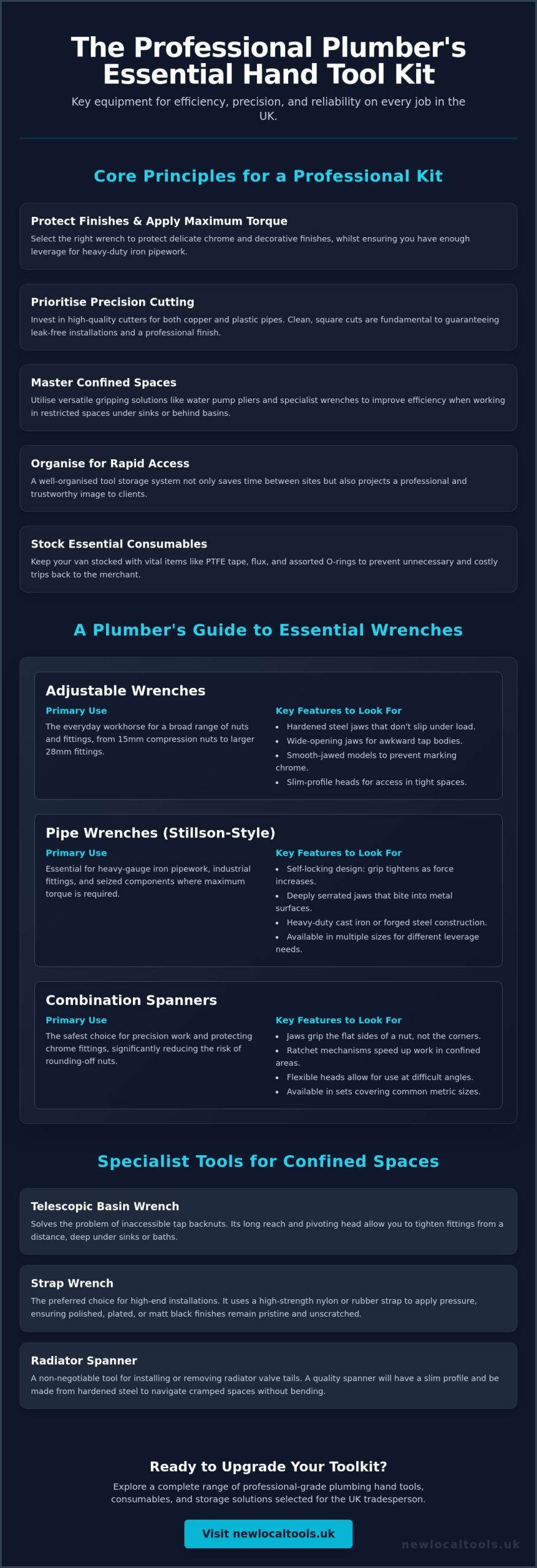
- Identify the specific wrenches needed to protect delicate chrome finishes whilst maintaining enough torque for heavy-duty iron pipework.
- Build a plumber essential hand tools list that prioritises precision cutting for both copper and plastic pipes to ensure leak-free installations.
- Discover how versatile gripping solutions like water pump pliers and locking Mole grips improve efficiency when working in restricted spaces.
- Compare tool storage options to find a system that organises equipment for rapid access and projects a professional image to clients.
- Learn which consumables, including PTFE tape and assorted O-rings, are vital to keep in stock to avoid unnecessary trips to the merchant.
Table of Contents
- Essential Plumbing Wrenches and Spanners for Every Toolkit
- Precision Cutting and Pipe Preparation Tools
- Professional Pliers and Gripping Solutions
- Tool Storage and Worksite Organisation
- Consumables and Maintenance Essentials
Essential Wrenches and Spanners
A plumber’s reputation often rests on the ability to turn a nut without rounding the edges or scratching a designer tap. Efficiency on site depends on having the right leverage and jaw capacity for each task. Selecting tools with hardened steel jaws and slim-profile heads ensures the equipment lasts for years whilst fitting into the increasingly compact spaces found in modern UK housing. Ergonomic grips reduce hand fatigue during long shifts and provide a secure hold when working with wet or oily hands.
Adjustable Wrenches
Wide-opening adjustable wrenches handle the broadest range of jobs — from small 15mm compression nuts up to larger 22mm and 28mm fittings. The Stanley STA090950 300mm MaxSteel Adjustable Wrench is a reliable everyday choice: the MaxSteel jaw stays tight under load and doesn’t back off on wet fittings. For tighter spaces under sinks or behind pedestals, the Stanley STA090947 150mm MaxSteel fits where a full-size tool simply can’t go. A 10-inch (250mm) model is widely considered the most versatile single size for domestic work — enough leverage for stubborn 22mm fittings whilst compact enough for vanity units. If you need a slim profile with a soft grip for longer shifts, the Faithfull FAIAS200C 200mm Soft-Grip Adjustable Wrench is worth having alongside.
For chrome-plated surfaces, smooth-jawed spanners are vital to prevent teeth marks. The Bahco BAH8072 255mm Central Nut Adjustable Wrench and Bahco BAH8071 205mm Wide Mouth Adjustable Spanner both offer the wider jaw opening that makes awkward tap bodies and back nuts far less frustrating. For extra reach on large fittings, the Bahco BAH9031XE 218mm ERGO Extra Wide Jaw Wrench provides additional clearance with a phosphate finish that resists corrosion in damp environments.
Pipe Wrenches
When dealing with heavy-gauge iron pipework or seized fittings, an adjustable spanner doesn’t have enough bite. A Stillson-style Pipe Wrench uses a self-locking design where the harder you pull, the tighter the grip becomes. Serrated jaws dig into smooth metal surfaces to ensure zero slippage under high torque. The Irwin REC30018 450mm Stillson Wrench is the trade standard for the largest jobs. The Irwin REC30012 300mm cover tighter situations — carrying two sizes means you’re never applying a 450mm wrench in a space that only needs a 200mm one.
Combination Spanners
For chrome fittings and precision work, a combination spanner is the safer choice than an adjustable. The Wera JOKER Ratchet Combination Spanners — available from 8mm through 19mm — are built around a self-setting jaw that grips the flat of the nut rather than the corners, significantly reducing the risk of rounding on older fittings. The ratchet mechanism means you don’t need to reposition the spanner between turns in confined spaces. The Faithfull FAISPARAT19 19mm Ratchet Combination Spanner and Faithfull FAISPARAT15 15mm Ratchet Combination Spanner offers the same advantage with a flexible head for working at an angle. For volume jobs where you need a full set, the [Blue Spot 04312 8-17mm Flexible Ratchet Spanner Set — 6 Piece covers the most common domestic sizes in one purchase.
Specialised Wrenches for Confined Spaces
Modern bathroom designs often place pipework in tight voids behind pedestals or under deep-seated baths. A telescopic basin wrench solves this problem with its long reach and pivoting head, allowing the user to tighten backnuts from a distance. For high-end installations where aesthetics are paramount, a strap wrench is the preferred choice. It uses a high-strength nylon or rubber strap to apply pressure, ensuring that polished brass or matt black finishes remain pristine. Additionally, a radiator spanner is a non-negotiable addition for installing or removing valve tails. Look for slim-profile heads and hardened steel construction to ensure these tools can navigate cramped spaces without bending. Using the right tool for the right space prevents job delays and protects the client’s property from accidental damage.
Compression Fitting Spanner
Compression fitting work needs its own dedicated tool. The Monument MON2032 15/22mm Compression Fitting Spanner grips the hexagonal body of a compression fitting cleanly without slipping onto the olive or pipe body — a common problem with standard adjustable wrenches on this type of joint.
Wrenches for Confined Spaces
Modern bathroom designs often place pipework in tight voids behind pedestals or under deep-seated baths. A telescopic basin wrench solves this with its long reach and pivoting head, allowing backnuts to be tightened from a distance. For high-end installations where aesthetics matter, a strap wrench uses a high-strength nylon strap to apply pressure without marking polished brass or matt black finishes. Using the right tool for the right space prevents job delays and protects the client’s property.
Precision Cutting and Pipe Preparation Tools
Achieving a leak-free joint starts long before the press tool is engaged. Precision cutting is the baseline for professional plumbing — uneven or jagged pipe ends are the primary cause of seal failure in modern push-fit and press-fit systems. Without quality cutting equipment, tradespeople risk damaging expensive fittings and wasting materials on site.
Copper and Plastic Tube Cutters
Copper pipework requires a rotary tube cutter to produce a perfectly circular, burr-free finish. These tools use a hardened steel wheel to score through the metal without deforming the pipe wall. Professional models often store a spare cutting wheel in the handle — vital for maintaining productivity when a blade dulls. Replace cutter wheels as soon as they begin leaving a significant burr or require excessive force; for a busy professional, this typically happens every three to six months.
For plastic waste pipes and PEX, a ratcheting cutter is the superior choice. It provides rapid one-handed operation and prevents the crushing effect that a standard saw causes on plastic. The Irwin GLM Minor Tube Bender 15-22mm Kit handles both bending and prep work for the most common domestic copper sizes.
In extremely restricted voids or between floor joists, auto-cut circular tools are indispensable — they snap onto the pipe and rotate in a confined radius where a standard adjustable cutter can’t fit.
Saws and Deburring Equipment
A junior hacksaw remains a permanent fixture in the professional toolbag. Its compact frame handles metal brackets, stubborn bolts, and oversized plastic soil pipes in tight corners far better than a full-sized version.
Once the cut is made, deburring is not optional. An internal and external reamer removes the sharp swarf and internal ridges that would otherwise restrict water flow or slice through an O-ring during assembly. A flat metal file tidies rough edges on threaded rods and copper tails. Skipping deburring is the most common cause of callbacks on push-fit and compression joints.
Professional Pliers and Gripping Solutions
Pliers act as an extension of the tradesperson’s reach — providing the torque needed to break seized joints or the delicacy required for intricate boiler components. Relying on the wrong pliers turns a ten-minute job into an hour of remedial work. Professionals choose tools that balance high-leverage performance with a slimline design suited to UK utility cupboards and bathrooms.
Water Pump Pliers and Mole Grips
Water pump pliers — also called slip-joint pliers — are the most-used tool in a plumber’s bag. Premium models feature a self-locking channel mechanism that keeps the jaw width fixed once set, preventing the tool from backing off mid-turn and slipping onto knuckles. The jaws must feature a V-shaped or multi-point contact profile to distribute pressure evenly across a hexagonal nut rather than concentrating force on two corners. Many experienced plumbers favour Stanley for their heat-treated jaws that maintain bite over years of heavy use. For tasks that require a permanent, hands-free hold, locking pliers are indispensable. They allow a plumber to clamp down on a stubborn component and apply a second wrench to break a seized connection — without a second pair of hands. Standard pliers can’t do this job.
Specialist Gripping Tools
An olive puller is worth carrying specifically for replacing valves on existing copper pipework. It removes compression rings cleanly without damaging the pipe — far preferable to cutting back and re-running. For broken threaded ends snapped off inside a fitting, an internal pipe wrench is the only clean solution.
| Tool | Primary Use | When You Need It |
|---|---|---|
| Water Pump Pliers | Adjusting to various pipe and nut sizes | General assembly and maintenance |
| Mole Grips | Locking onto components for a hands-free hold | Removing seized or stubborn fittings |
| Needle-Nose Pliers | Intricate tasks and wiring | Boiler repairs and small clip placement |
| Olive Puller | Removing compression rings (olives) | Replacing valves on existing pipework |
Utility keys cover the jobs that come up every week but rarely get dedicated space in the toolbox. The Blue Spot 30138 4 Way Universal Utility Key and Amtech S4602 Universal Utility Key both handle stopcocks, meter boxes, and drain covers — the kind of tool that earns its place on every call-out. The BlueSpot 30147 Manhole Cover Keys 115mm — 2 Piece rounds out the kit for any work involving drainage access.
For radiator bleeding, the Blackspur RK120 Winged Zinc Alloy Radiator Bleed Keys are inexpensive enough to keep a set in every bag. The Faithfull FAIRADKEY Brass Radiator Keys are the more durable option for volume heating work.
Tool Storage and Worksite Organisation
Modular Storage Systems
Interlocking modular systems have changed how tradespeople transport equipment. Stackable hard-shell boxes that click together allow a customised setup based on the day’s requirements — leave what you don’t need in the van. For the UK market, IP-rated weather seals are essential; they prevent water ingress on damp worksites and stop steel hand tools from rusting. Wheeled base units turn a heavy stack into a mobile workstation that follows the plumber from room to room on larger projects.
Tool Totes and Bags
Many plumbers prefer open-top textile totes for active site work. They provide immediate visibility and access to the most frequently used tools — water pump pliers, adjustable spanners, keys — without opening latches. A puncture-resistant waterproof base is non-negotiable: plumbing means wet floors and sharp tools in the same space. Internal pockets and elasticated loops keep smaller items upright rather than tangled at the bottom of the bag.
Consumables and Maintenance Essentials
Precision hand tools provide the control, but consumables are what actually deliver a leak-free finish. A plumber who carries the best wrenches but lacks a 15mm olive is forced to leave the site — wasting fuel and time. The small items often determine the profitability of a job.
PTFE Tape
PTFE is non-negotiable for any threaded connection. The Krobahn KB-TPPW1275 12m Water PTFE Tape is practical to keep multiples of — white tape for all water systems. For gas work, yellow gas-rated tape is the correct specification: the Krobahn KB-TPTG1202 12mm Gas PTFE Tape. Never use white tape on gas connections.
Pipe Cement and Jointing
For plastic waste pipe, the Everbuild EVBP16PIPE 250ml PVC Pipe Cement sets quickly and is compatible with standard solvent-weld fittings. Jointing compound provides extra security on traditional threaded iron or brass fittings used alongside hemp or tape.
Seals and Hardware
Keep a selection of O-rings, tap washers, and 15mm/22mm copper olives in a dedicated restock box. Always replace olives rather than reusing them — a fresh olive costs pennies; a callback costs an hour. Silicone lubricant alongside them ensures push-fit components seat properly without displacing the rubber seal during assembly.
Equip Your Kit for Maximum Site Efficiency
Reliability is non-negotiable on a professional site. Investing in durable tools from trusted manufacturers gives the confidence to tackle any installation without returning to the van for missing gear. New Local Tools stocks professional hand tools with free delivery on all orders over £100.
Browse all wrenches and spanners
Frequently Asked Questions
What is the most important hand tool for a plumbing apprentice to buy first?
Water pump pliers are widely considered the most important first purchase. They handle everything from tightening compression joints to gripping smooth pipes during assembly. A durable pair from a professional brand serves as the foundation for a kit that will last years of site work.
How often should a professional plumber replace their pipe cutter wheels?
Replace them as soon as they begin leaving a significant burr or require excessive force to complete a cut. For a busy professional, this typically happens every three to six months. Sharp wheels ensure the clean, square cuts that push-fit and press-fit connections depend on.
Can I use standard pliers instead of water pump pliers for plumbing?
Standard pliers are generally unsuitable. They lack the wide jaw capacity and adjustable leverage that pipe fittings require. Water pump pliers are specifically designed to apply high torque to circular and hexagonal components without slipping on wet surfaces.
What size adjustable wrench is most versatile for domestic plumbing?
A 250mm (10-inch) model is the most versatile single choice. It provides enough leverage for stubborn 22mm fittings whilst remaining compact enough for vanity units and under sinks. Look for slim jaws and a quality adjustment screw that stays set during use.



 153 Leytonstone Road, E15 1LH
 Log into your account


