
 153 Leytonstone Road, E15 1LH, London






The most powerful router on the shelf is often the wrong tool for the job. Selecting a machine based on raw wattage alone frequently leads to a tool that is too heavy for delicate trim work or lacks the specific collet capacity required for heavy-duty timber. Many tradespeople and DIY enthusiasts across the UK find themselves stuck between 1/4-inch and 1/2-inch options, whilst others worry that modern cordless motors cannot deliver the necessary torque for specialised professional applications. Understanding how to choose a wood router requires a pragmatic look at technical specifications versus real-world site requirements.
This guide provides the expertise needed to master the technical specifications and practical requirements to select the perfect wood router for any professional or DIY project. Readers will gain a definitive understanding of collet capacities, find confidence in the corded versus cordless debate, and identify the essential features for high-performance woodworking in 2026. From brushless motor efficiency to the latest UKCA safety standards, this breakdown ensures every purchase is a reliable investment for the workshop or the site.
Key Takeaways
- Identify the specific applications for plunge and fixed-base models to ensure the tool suits decorative edging or deep joinery tasks.
- Master how to choose a wood router by comparing 1/4-inch and 1/2-inch collet capacities against the intended timber thickness and bit size.
- Assess the performance gap between modern 18V cordless platforms and high-torque corded units for heavy-duty professional site work.
- Determine the ideal variable speed settings and motor power requirements to maintain safety whilst working with different material densities.
- Learn essential maintenance protocols for collets and bearings to maximise the lifespan and precision of professional woodworking equipment.
Table of Contents
-
Understanding Wood Router Fundamentals: Applications and Base Types
-
Technical Specifications: Collet Sizes and Power Requirements
-
The Professional Selection Framework: Matching Router to Task
Understanding Wood Router Fundamentals: Applications and Base Types
A wood router is a high-speed power tool designed for hollowing out areas in hard materials like timber, plastics, and composites. Many professionals consider it the most versatile tool in the workshop because it handles everything from decorative edging to complex joinery. When researching What is a Wood Router?, it becomes clear that the tool consists of a high-speed electric motor and a base that controls the bit depth. Motors spin the bit at speeds often exceeding 20,000 RPM, allowing for clean, precise cuts that require minimal sanding.
Deciding how to choose a wood routerdepends heavily on the balance between precision and raw cutting power. Whilst a heavy-duty machine provides the torque needed for deep grooves in dense oak, a lighter model offers the control required for delicate inlay work. Most modern units found in a professional shop feature variable speed motors. This feature is essential for matching the rotation speed to the diameter of the bit and the hardness of the workpiece.
Primary applications for these tools include:
-
Decorative edging and profiling for furniture and cabinetry.
-
Joinery tasks such as cutting dadoes, rabbets, and dovetails.
-
Template routing for creating repetitive shapes accurately.
-
Recessing hinges and other hardware into doors or frames.
Fixed Base vs Plunge Base Routers
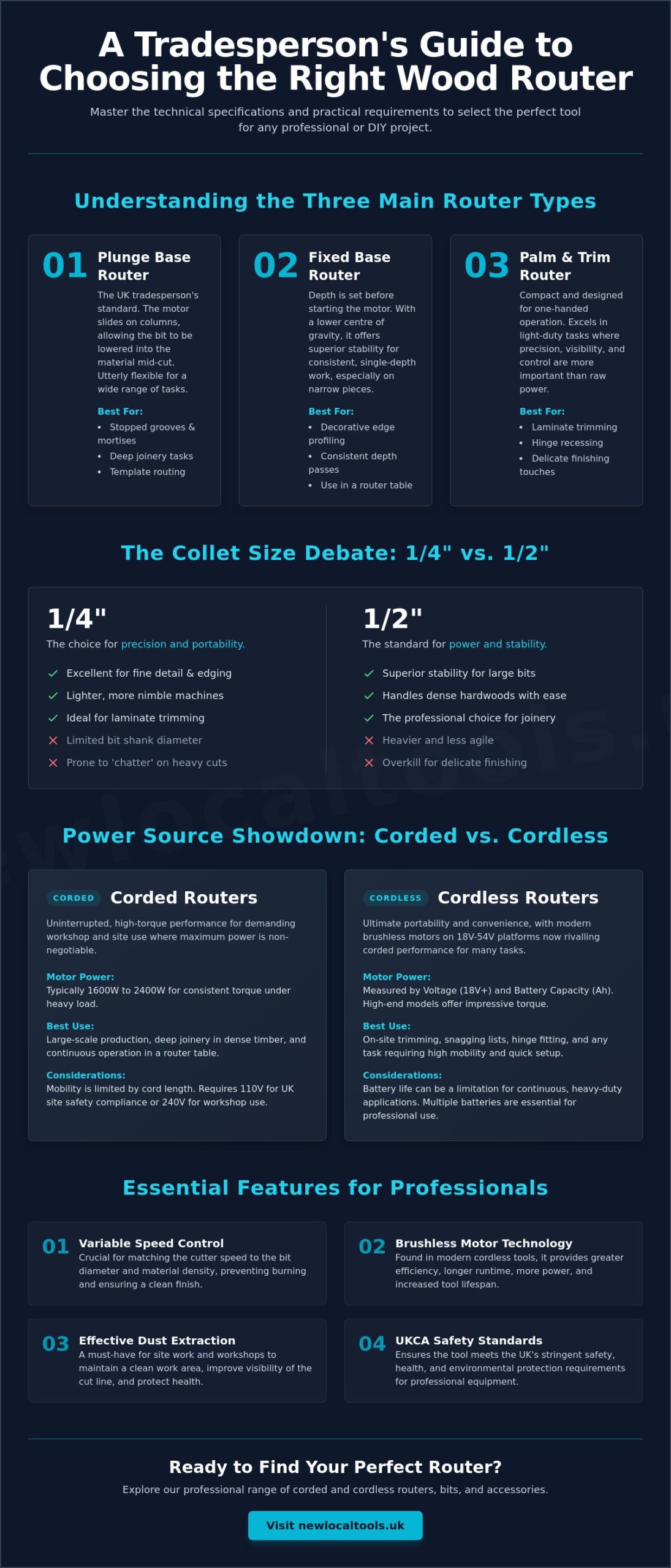
Plunge routers are the standard for UK tradespeople due to their inherent flexibility. These models allow the motor to slide up and down on spring-loaded columns. This means the bit can be lowered into the material whilst the motor is running. It is a vital feature for stopped grooves, mortises, or any cut that does not start at the edge of the timber. Fixed base models require the depth to be set before the motor starts. They are ideal for edge profiling where a constant depth is required. Fixed bases often have a lower centre of gravity, providing better stability on narrow workpieces. Many professionals favour the plunge base for its versatility in complex joinery and template work.
The Rise of the Palm and Trim Router
Technical Specifications: Collet Sizes and Power Requirements
The collet is the precision-engineered steel sleeve that secures the router bit to the motor shaft. In the UK market, standards are strictly divided between 1/4-inch and 1/2-inch capacities. This choice dictates every subsequent purchase, from the diameter of the cutters to the physical weight of the machine. Larger collets provide a significantly more stable platform for heavy-duty cutting. They allow for longer, wider bits that won’t vibrate or ‘chatter’ when removing large amounts of material. When deciding how to choose a wood router, the collet size is often the first technical hurdle to clear because it determines the tool’s maximum bit capacity and overall stability.
Power requirements are measured differently depending on the power source. For corded models, look at the wattage. A professional 1/2-inch plunge router typically requires 1600W to 2400W to maintain constant torque under load. For cordless units, the focus shifts to voltage and Amp-hours (Ah). Modern 18V or 54V brushless motors now rival corded performance for many tasks. Selecting the correct class of machine involves Choosing the Right Router Size based on the anticipated workload and material density. Professional users on UK construction sites must also consider the choice between 110V for site safety and 240V for workshop convenience.
The 1/4-Inch Router: Precision and Portability
These compact machines are the workhorses of light joinery and on-site finishing. Most 1/4-inch models feature motors rated between 600W and 900W. They’re the standard choice for hinge recessing, laminate trimming, and edge profiling where manoeuvrability is more important than raw bulk. One major advantage is the availability of affordable router bits . Because the bits are smaller, they cost less and are widely available in various profiles for decorative work. Professionals often keep a dedicated 1/4-inch machine specifically for delicate tasks whilst leaving the heavy lifting to larger units. You can find a wide range of these compact units in the power tool category for immediate dispatch.
The 1/2-Inch Router: Industrial Power for Heavy Timber
For tasks like worktop fitting, cutting large mouldings, or deep trenching, a 1/2-inch router is non-negotiable. These machines deliver high torque through motors exceeding 1600W, ensuring they don’t bog down in hardwoods like oak or walnut. The thicker shank of a 1/2-inch bit offers superior heat dissipation and structural strength. This makes them the primary choice for permanent workshop setups and router tables. If the project involves removing substantial amounts of material in a single pass, the stability of a 1/2-inch collet is essential for a clean finish and operator safety. These machines are heavier, but that mass helps to dampen vibrations during intense cutting cycles.
Cordless vs Corded Routers: Choosing the Right Power Source
Modern battery technology has transformed the woodworking landscape. When professionals ask how to choose a wood router in 2026, the debate between corded and cordless is now the central question. For most 1/4-inch applications, cordless technology now rivals corded performance. Brushless motors and high-output battery cells provide the torque needed for moulding and trimming without the restriction of a lead. This shift is particularly evident amongst site-based tradespeople who value rapid setup and mobility.
Corded models still hold a dominant position for continuous, high-load 1/2-inch work. Heavy timber removal and kitchen worktop fitting generate significant heat and demand constant power. A corded machine ensures that the motor maintains peak RPM throughout a long cut without the risk of thermal shutdown or battery depletion. Battery compatibility with existing tool kits often dictates the final brand choice. Sticking to a single platform like Makita or DeWalt allows for a more efficient workflow and lower long-term costs across a professional fleet.
The Benefits of Cordless Freedom
Eliminating trip hazards is a primary safety benefit on busy UK construction sites. Cordless routers remove the need for trailing extension leads, which often snag on workpieces or workbenches during complex manoeuvres. Brushless motors in these units provide high efficiency and longer tool life compared to older brushed designs. They’re ideal for quick tasks like rounding over edges or recessing hinges where dragging out a transformer and cable would be inefficient. For many, the convenience of a cordless palm router from the cordless power tools range outweighs the raw power of a mains-operated equivalent.
When to Stick with Corded Power
High-intensity tasks like cutting multiple kitchen worktop joints are better suited to corded power. These jobs require sustained high-torque performance that can drain even the largest batteries quickly. In workshop environments, corded tools are often preferred because dust extraction is already tethered to the tool. Since a vacuum hose is already required, the presence of a power cord is less of an inconvenience. Corded models also offer a lower initial cost. Buyers don’t need to invest in expensive chargers and high-capacity battery packs to get started. It’s a pragmatic choice for those who do most of their routing at a fixed bench or in a router table.
The Professional Selection Framework: Matching Router to Task
Selecting a high-performance router requires a precise alignment between tool capacity and material hardness. Hardwoods like oak and mahogany demand consistent torque, whereas softer materials allow for higher speeds but require a steady hand to avoid grain tear-out. Identifying how to choose a wood router means evaluating the specific resistance of the timber and selecting a motor that won’t bog down during the pass. If the motor struggles, the bit heat increases, which leads to burnt timber and premature bit wear.
Variable speed control is vital for using larger bits safely. As the diameter of a router bit increases, the outer edge travels significantly faster than a smaller bit at the same RPM. Reducing the speed prevents the bit from burning the wood or vibrating excessively. Ergonomics and handle placement also play a massive role in the quality of the finished cut. D-handle models offer a lower centre of gravity for edge work, whilst standard twin-handle plunge bases provide the balanced downward pressure needed for central trenching and template routing.
Summary Comparison of Router Types
The following table provides a quick-reference guide to help tradespeople match the tool to the specific site or workshop application.
| Tool | Primary Use | When You Need It |
|---|---|---|
| Trim Router | Laminate trimming and light edge work. | Finishing kitchen units or small decorative profiles on-site. |
| 1/4" Plunge Router | Hinge recessing and general joinery. | On-site tasks where portability and depth control are key. |
| 1/2" Heavy Duty Router | Worktop joints and large mouldings. | Heavy timber trenching or permanent workshop table setups. |
Essential Features for Professional Accuracy
Effective dust extraction ports are essential to maintain visibility and protect respiratory health. Routers produce a significant volume of fine dust that can quickly obscure the cut line and fill the workspace. A clear path for waste removal ensures the bit stays cool and the operator can see exactly where the tool is heading. Professionals can find a wide selection of models featuring these high-end specifications at the New Local Tools shop. Selecting a machine with a robust fence and clear baseplate will further enhance the accuracy of every pass. Browse the latest arrivals and special offers to secure a professional-grade machine that delivers consistent results on every job.
Accessories and Maintenance: Maximising Router Performance
The final decision on how to choose a wood router shouldn’t ignore the ecosystem of accessories. A high-end motor won’t compensate for a blunt or poor-quality bit. In a professional trade environment, the quality of the cut is often more dependent on the bit than the tool itself. Investing in precision guide rails and fences is also necessary for achieving straight, repeatable cuts across large panels or during complex joinery tasks. Regular maintenance of collets and bearings extends the life of the motor and prevents costly site downtime.
When considering how to choose a wood router for long-term use, professionals must account for the ongoing cost and availability of high-quality cutters. Standardised guide bushes and dust extraction adapters from the New Local Tools shop ensure the machine remains compatible with various jigs and workshop vacuum systems. Keeping a stocked kit of consumables prevents project delays and maintains the precision expected in high-end woodworking.
Essential Router Accessories and Consumables
Selecting the right cutter material is critical for efficiency. High-Speed Steel (HSS) bits are affordable and sharp but dull quickly in hardwoods. Tungsten Carbide Tipped (TCT) cutters are the industry standard for 2026. These bits feature a hard carbide edge brazed to a steel body, providing superior heat resistance and edge retention whilst working with abrasive materials like MDF or plywood. This attention to detail in material selection is what defines the high-quality home and garden products available at Living Chic.
| Item | Use | Notes |
|---|---|---|
| TCT Router Bits | General routing in hardwood and MDF. | Stay sharp significantly longer than HSS in abrasive materials. |
| Collet Cleaning Kit | Removing resin and pitch build-up. | Prevents bit slippage and ensures maximum clamping force. |
| Replacement Carbon Brushes | Motor maintenance for corded units. | Check every 50 hours of use to prevent commutator damage. |
Maintenance and Safety Protocols
Safety is the primary concern when operating high-speed machinery. Always disconnect the power or remove batteries before changing bits or making adjustments to the base. A bit that isn’t seated correctly can vibrate at high RPM, leading to tool damage or injury. Check for bit sharpness regularly; blunt bits force the motor to work harder, which causes the timber to burn and strains the internal bearings. Ensure the collet is tightened correctly using the manufacturer’s specified wrenches to prevent bit slippage during a pass.
Reliability is built into the design of leading brands. Explore the latest DeWalt routers and Makita routers for machines that offer robust collet systems and easy-access brush ports. Keeping the motor housing free from dust build-up via compressed air or a vacuum will prevent overheating and ensure the tool delivers peak performance for years to come.
Frequently Asked Questions
Can a 1/4-inch router bit be used in a 1/2-inch router?
Yes, a 1/4-inch bit can be used in a 1/2-inch router provided a high-quality reduction sleeve or a dedicated 1/4-inch collet is used. Most professional 1/2-inch routers include these adapters as standard equipment. It’s vital to ensure the sleeve is fully seated and the bit is clamped securely to prevent vibration. This flexibility allows tradespeople to employ smaller, more affordable bits for detail work whilst retaining the raw power of a larger machine.
What is the best router for cutting kitchen worktops?
A heavy-duty 1/2-inch plunge router with a minimum power rating of 1600W is the standard choice for cutting kitchen worktops. These machines provide the necessary torque to drive deep cutters through dense laminate or solid timber worktops without stalling. Using a 1/2-inch shank bit is essential for stability when using a worktop jig. This configuration ensures clean, square joints that are vital for a professional finish on-site in the UK market.
How often should router bits be sharpened or replaced?
Router bits should be sharpened or replaced immediately if they begin to burn the timber or show visible nicks on the cutting edge. High-volume trade users often replace TCT bits once the cutting resistance increases, as blunt bits strain the motor and bearings. Whilst HSS bits can be touched up with a diamond stone, TCT bits usually require professional sharpening. Keeping bits clean from resin build-up also extends their productive lifespan between replacements.
What safety equipment is required when using a wood router?
Essential safety equipment includes impact-resistant goggles, high-quality ear defenders, and a dust mask rated to at least P2 or P3. Wood routers operate at extremely high RPMs and generate significant noise and fine dust. Users should also ensure that dust extraction is connected whenever possible to maintain cut-line visibility. Avoid wearing loose clothing or jewellery that could get caught in the spinning bit, and always wear sturdy footwear in the workshop or on-site.




 153 Leytonstone Road, E15 1LH
 Log into your account


