
 153 Leytonstone Road, E15 1LH, London





Table of Contents
Defining the Best Cordless Reciprocating Saw for Demolition Tasks
A demolition Reciprocating saw is not just another cutting tool; it is a heavy-duty instrument engineered specifically for destructive cutting through tough materials. Unlike its counterparts used for pruning or fine carpentry, a demolition saw is built to withstand the brutal conditions of a job site, prioritising power and durability over precision. Its primary role is to dismantle structures by slicing through a mixture of materials quickly and efficiently.
In recent years, cordless technology has become the preferred choice for site demolition, largely due to significant safety and mobility advantages. The industry has seen a major transition away from traditional 110V corded tools. Modern high-output brushless cordless systems now deliver comparable, and in some cases superior, power without the inherent risks of trailing cables. During a typical demolition project, a professional will encounter a wide range of materials, including nail-embedded timber, thick-gauge steel pipes, cast iron, and even sections of masonry. The best cordless reciprocating saw for demolition must be able to handle all of these without faltering.
Why Cordless Wins on the Demolition Site
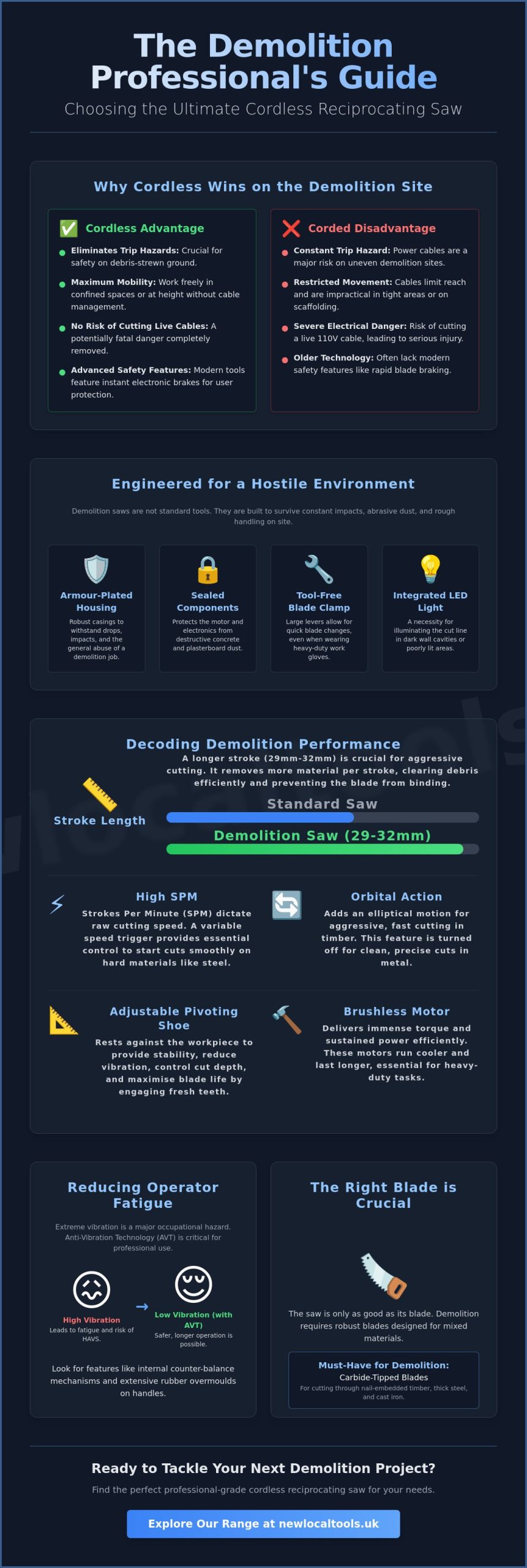
The move towards cordless on professional demolition sites is driven by critical health and safety considerations. The most significant benefit is the complete elimination of trip hazards posed by power cables, which can be a major risk on uneven, debris-strewn ground. Furthermore, it removes the severe danger of accidentally cutting through a live power cable, a scenario that can have fatal consequences. This freedom from cords grants operatives greater mobility, allowing them to work more effectively in confined spaces like crawlspaces or at height on scaffolding, where managing a cable would be impractical and unsafe. Many modern cordless models also feature advanced safety mechanisms, such as instant electronic braking systems, which stop the blade immediately upon trigger release, providing an additional layer of user protection not always found on older corded saws.
The Demolition Environment vs Standard Cutting
The demolition environment is uniquely hostile to power tools. It is characterised by high levels of abrasive dust from concrete and plasterboard, constant impacts, and rough handling. To survive these conditions, professional demolition saws require robust, armour-plated tool housings and sealed components to protect the motor and electronics. Another key feature dictated by the environment is the need for a tool-free blade change system. Operatives wear heavy-duty work gloves for protection, making small, fiddly mechanisms impossible to use. A large, lever-action blade clamp is essential for fast and easy blade swaps on the job. Finally, demolition often involves cutting into dark wall cavities, under floors, or in poorly lit areas. An integrated LED work light is therefore not a luxury but a necessity, illuminating the cut line and improving both safety and accuracy.
Critical Features for Heavy-Duty Demolition Performance
To find the best cordless reciprocating saw for demolition, one must look beyond the brand name and analyse the core technical specifications that dictate performance. The relationship between Strokes Per Minute (SPM), stroke length, and orbital action is what separates a true demolition powerhouse from a standard-duty saw. A high SPM provides the raw speed, but it is the stroke length—typically 29mm to 32mm on professional models—that is essential for aggressive cutting. A longer stroke clears more material with each movement, preventing the blade from getting bogged down in thick timber or metal and efficiently ejecting sawdust and debris (known as swarf).
Orbital action is another must-have feature for rapid timber demolition. This function introduces an elliptical motion to the blade’s stroke, creating a more aggressive, gouging cut that tears through wood at a much faster rate than a standard straight-line action. For metal cutting, this feature is turned off to ensure a cleaner cut and prolong blade life. Finally, an adjustable pivoting shoe is critical. By resting the shoe firmly against the workpiece, the operator gains stability, reduces vibration, and can control the depth of cut. This not only improves safety but also maximises the usable life of the blade by allowing the user to engage fresh teeth as others wear down.
Power and Stroke Length Dynamics
The immense torque required to force a blade through thick steel or dense hardwood is delivered by advanced battery and motor systems. High-voltage platforms, such as 54V or 40V systems, are specifically designed to provide the sustained power needed for these demanding tasks, rivalling the performance of corded tools. However, even modern 18V systems, when paired with a high-output battery and a brushless motor, can deliver exceptional demolition performance. A key component of this power delivery is a variable speed trigger, which gives the operator precise control to start a cut smoothly on a hard surface like steel pipe, preventing the blade from skittering. At the heart of these tools is the brushless motor.
Vibration Control and User Fatigue
Comparing Top Professional Cordless Reciprocating Saws
When selecting a professional-grade tool for demolition, the market is dominated by three key brands renowned for their power, reliability, and robust ecosystems. Here, we’ll evaluate the market leaders, focusing on the flagship models from DeWalt, Makita, and Milwaukee that we stock and recommend for demolition work. For tradespeople already invested in a specific battery platform, purchasing a "Body Only" tool is the most cost-effective option. However, for those starting fresh or upgrading an entire system, a full kit including high-capacity batteries and a charger offers excellent value. It’s also crucial to consider the warranty and availability of UK-based support, as professional tools work hard and require dependable backup.
The Comparison Framework
To help you decide, this summary table breaks down the top contenders with key technical specifications. It identifies models best suited for raw power ("Best for Timber and Heavy Demolition"), those with a good balance for metalwork, and a more compact option for working in restricted areas. The table is designed to be clear and easy to read, even on a mobile device, focusing on the data that matters most to a professional on site.
Selecting Essential Accessories and Consumables
A professional saw is ultimately only as effective as the blade attached to it. Investing in a high-performance tool and then using substandard blades is a false economy that leads to slow cutting, premature tool wear, and potential safety risks. For demolition, blades fall into two main categories: Bi-Metal and Carbide-Tipped. Bi-Metal blades offer good flexibility and are a cost-effective choice for general-purpose wood and metal cutting, whilst Carbide-Tipped blades provide exceptional durability and are essential for cutting through hardened metals, cast iron, and masonry. Beyond blades, sustained work requires high-capacity batteries — a 5.0Ah battery is the recommended minimum for demolition, with higher capacities offering longer runtimes. To keep the job moving without interruption, a multi-bay rapid charger is a wise investment, ensuring there is always a fresh battery ready to go.
Blade Selection for Demolition
Understanding blade terminology is key to matching the right consumable to the material. TPI (Teeth Per Inch) is a critical factor: a low TPI (e.g., 6 TPI) has large, aggressive teeth for very fast cutting in timber, whereas a high TPI (e.g., 18-24 TPI) has smaller teeth for a smoother, slower cut in metal. For demolition, you need purpose-built "Demolition" blades. These are typically thicker and taller than standard blades to prevent bending and snapping when encountering unexpected resistance, such as a hidden nail or screw. Our professional guide to choosing saw blades offers more in-depth advice on this topic. The following table provides a simple restock framework for your van.
| Item | Use | Notes |
|---|---|---|
| 6 TPI Wood Demolition Blade | Fast, aggressive cutting of nail-embedded timber, joists, and roofing. | The workhorse blade for most structural timber removal. |
| 10/14 TPI Metal Demolition Blade | Cutting medium-to-thick steel pipe, rebar, and angle iron. | Variable TPI helps to reduce snagging and vibration in metal. |
| Carbide-Tipped "The Torch" Blade | Extreme applications: cast iron, stainless steel, and other hardened metals. | Higher cost per blade but essential for materials that destroy Bi-Metal blades. |
| Carbide Grit Masonry Blade | Cutting through brick, breeze block, and plasterboard. | Not for precision work; used for creating openings or removing sections. |
Battery Management on Site
Effective battery management is crucial for maintaining productivity with cordless demolition tools. Cold weather can significantly impact the performance and charge capacity of lithium-ion batteries; it is advisable to keep them in a warmer environment (like the cab of a van) before use on a cold day. It is also important to understand that brushless tools are engineered to draw a large amount of current to achieve their peak performance. For this reason, they require high-discharge batteries, often designated by the manufacturer. Using a standard, smaller capacity battery on a high-demand tool will result in poor performance and a very short runtime. To ensure you have the right high-discharge batteries and chargers , exploring a dedicated range of Power Tool Accessories can help you build a kit that maximises on-site efficiency.
Maximising Tool Longevity on the Job Site
Professional power tools are a significant investment, and their lifespan can be extended with proper care and maintenance, even in a harsh demolition environment. After working with masonry or plasterboard, it is vital to clean the tool thoroughly. The fine, abrasive dust generated by these materials can work its way into the motor and mechanics, causing premature wear. Regular inspection and maintenance are key. Before every shift, blades should be checked for signs of heat damage (blueing), missing teeth, or bending, as a damaged blade is a significant safety hazard. A small amount of lubricant on the reciprocating rod can also help to reduce friction and prevent overheating during prolonged use. Finally, professional storage is essential for protecting tools during transit between sites.
Professional Storage Solutions
How you store and transport your tools is as important as how you use them. Leaving a high-value tool loose in the back of a van is a recipe for damage. We recommend investing in brand-specific stackable case systems, such as those offered by Stanley or the tool manufacturers themselves. These systems not only protect the tools from impact but also keep them organised and easy to locate. Storing tools in a dry, organised centre, such as a dedicated van racking system or workshop cabinet, also prevents moisture from causing oxidation on battery terminals and internal components. To protect your investment, explore our range of professional tool storage solutions. And when you’re ready to upgrade, you can browse the full range of professional tools, with free UK delivery available on orders over £100.
Frequently Asked Questions
Can a cordless reciprocating saw really cut through cast iron pipes?
What is the difference between a sabre saw and a reciprocating saw?
There is no difference; the terms are used interchangeably. "Sabre Saw" is an older term, whilst "Reciprocating Saw" is the more common and technically accurate name used today. Milwaukee’s brand name "Sawzall" is also often used as a generic term for this type of saw.
Do I need to use oil when cutting metal with a reciprocating saw?
While not strictly necessary for every cut, using a cutting fluid or oil is highly recommended when cutting thick or hardened metal. The lubricant reduces friction, which keeps the blade and the workpiece cooler. This results in a faster, cleaner cut, significantly extends the life of your saw blades, and can make the cutting process much smoother.



 153 Leytonstone Road, E15 1LH
 Log into your account


