
 153 Leytonstone Road, E15 1LH, London


A worker wielding a traditional hammer typically drives about six nails per minute, yet switching to a professional nail gun increases that output to approximately 20 nails per minute. This massive leap in productivity raises a critical question for any site professional: how much time does a nail gun save over the course of a full project? For those facing the physical fatigue of manual hammering and the frustration of missed deadlines, the answer is often the difference between a profitable week and a backlog of unfinished work.
Most tradespeople recognise that manual work leads to inconsistent depth and physical exhaustion, which ultimately slows down the entire build. This guide provides a detailed breakdown of the efficiency gains found in various construction tasks, revealing that a nail gun can reduce subflooring and roof decking time by a third, whilst framing tasks often see completion times cut in half. Readers will discover the specific benefits of different cordless models , a comparison of essential site tools, and the best practices for achieving a professional finish without the physical strain. Reliable equipment can be sourced directly from the online shop, ensuring London and UK-based tradespeople have the right tools to maximise site efficiency.
Key Takeaways
- Nail guns drive fasteners in milliseconds, removing the need to manually set and drive every individual nail by hand.
- An analysis of how much time does a nail gun save proves that mechanical tools are up to eight times faster than hammers on structural work.
- Choosing the correct tool for the task, such as a first fix gun for framing, is essential for reaching peak site productivity.
- High-capacity magazines and professional-grade consumables ensure an uninterrupted workflow by reducing the frequency of reloading on site.
- Professional-grade equipment from reliable manufacturers minimises mechanical downtime and delivers a consistent, high-quality finish for every project.
Table of Contents
Understanding the Efficiency Gap: Hammer vs Nail Gun
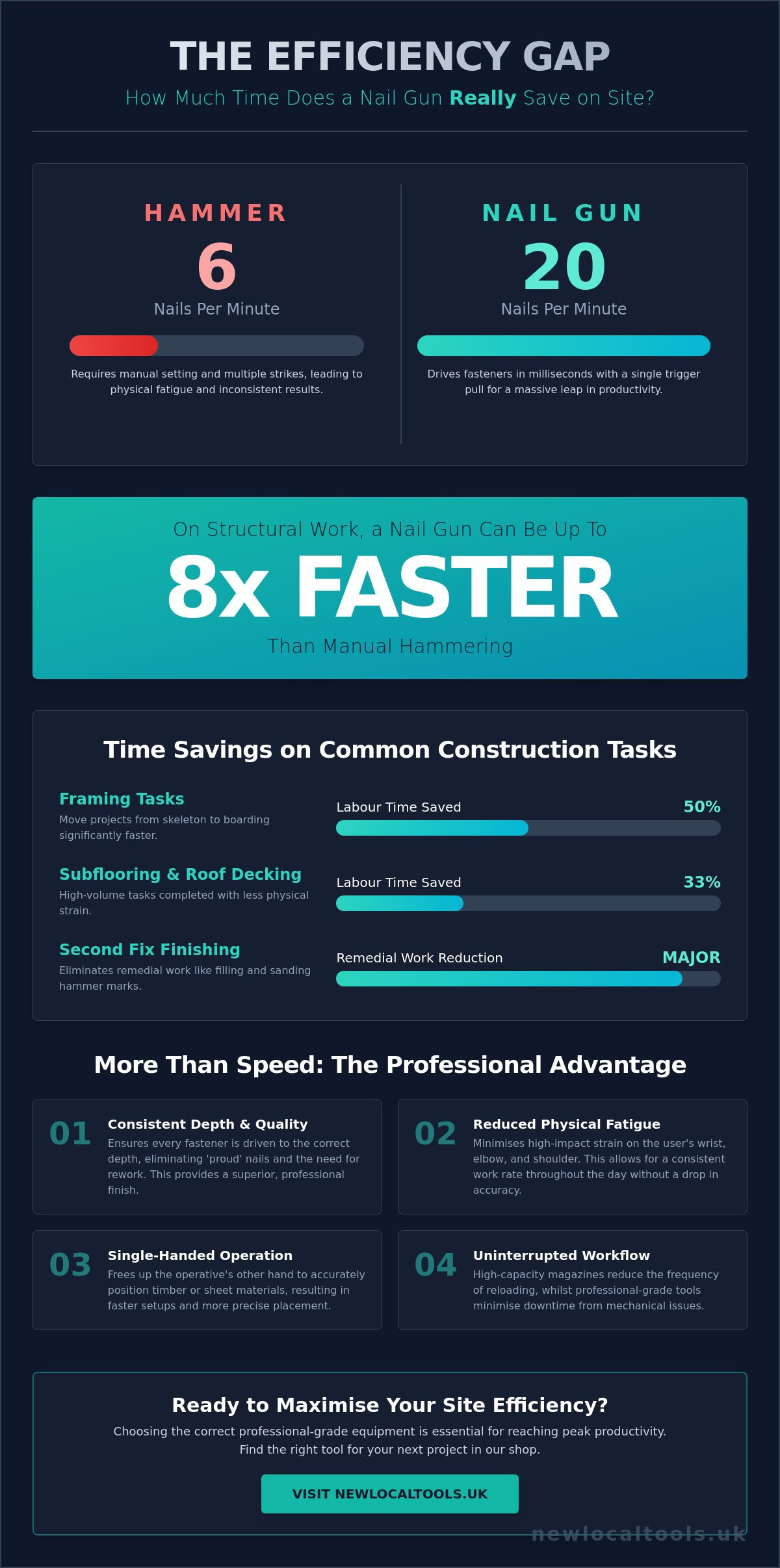
The transition from manual hammering to mechanical fastening represents one of the most significant leaps in construction productivity. Whilst a skilled carpenter can drive approximately six nails per minute with a traditional hammer, a professional nail gun allows an operative to drive around 20 nails in the same timeframe. When questioning how much time does a nail gun save, the answer begins with the mechanical action itself. A nail gun delivers a complete drive in milliseconds. In contrast, manual work requires a sequence of setting the nail, striking it multiple times, and often finishing the drive to ensure it sits flush.
Consistency is another major factor in the efficiency gap. Manual hammering often results in "proud" nails that require a second pass or corrective strikes. A high-quality tool from New Local Tools ensures a consistent depth of drive every time. This drastically reduces the hours spent on remedial work across a large project. It’s not just about the initial strike; it’s about eliminating the need to go back and fix errors.
The Physical Limitation of Manual Hammering
Manual hammering is a high-impact task that places significant strain on the wrist, elbow, and shoulder. As the shift progresses, muscle fatigue inevitably leads to a drop in accuracy. A tired operative is more likely to strike the timber at an angle or cause a "miss-hit" that damages the material. Setting small fixings manually is particularly slow and carries a high risk of finger injuries. By looking at the history of the nail gun, it’s clear these tools were developed specifically to overcome these human limitations and keep site work moving at a steady pace.
How Nail Guns Revolutionise Site Speed
The introduction of cordless and pneumatic nailers has changed how much time does a nail gun save on high-volume tasks like decking or framing. Modern units feature "bump fire" or contact trip modes. This allows the operative to keep the trigger depressed and fire a nail each time the safety tip touches the work surface. This creates a rhythmic, rapid-fire workflow that manual hammering simply cannot match.
Single-handed operation is equally vital for efficiency. Because the tool drives the fastener with a single trigger pull, the operative’s other hand remains free to position the timber or sheet material accurately. This eliminates the awkward balancing act often seen with manual hammers, resulting in faster setups and more precise professional finishes. The tool handles the force of the drive, preserving the user’s energy and allowing for a high work rate from the start of the morning until the final pack-down.
Calculating the Time Savings: From Seconds to Hours
Quantifying the exact productivity gains depends on the specific task, yet data consistently shows that mechanical fastening is four to eight times faster than manual alternatives. For a professional building a standard stud wall, switching from a hammer to a cordless framing nailer can save up to 60 minutes of labour. This efficiency allows projects to move from the skeleton stage to boarding much faster than previously possible. Understanding how much time does a nail gun save requires looking at the cumulative effect of these small, rapid actions over a full working day.
Beyond the structural speed, second fix tasks such as skirting and architrave installation benefit from a different kind of efficiency. Using a finish nailer eliminates the risk of hammer marks on delicate timber. This means less time is spent on sanding or filling damaged wood, resulting in a cleaner professional finish in a fraction of the time. Site professionals can find a variety of high-performance tools for these tasks at the online shop to streamline their workflow.
Repetition and Speed: The Numbers Behind the Tool
The core of the time-saving argument lies in the repetition. A professional operative can drive approximately one nail per second using a gun in bump-fire mode. Manual hammering, by comparison, averages between five and ten seconds per nail when accounting for positioning the fastener and multiple strikes. On projects that are fastener-heavy, such as laying subflooring or fixing battens, total daily savings can easily reach two to three hours. This reclaimed time allows a small team to complete a phase of work that would otherwise stretch into a second day of labour.
Impact on Large-Scale Framing and Roofing
Large-scale framing and roofing projects see the most dramatic improvements. These tasks require hundreds, if not thousands, of fixings where mechanical speed is vital to staying on schedule. On a roof, the operative often works in a balanced or restricted position. The ability to fire a nail instantly with one hand increases safety and allows the work to progress without the constant repositioning required for manual strikes. Whilst speed is a priority, following OSHA nail gun safety guidelines ensures that high productivity doesn’t come at the cost of site accidents.
Reduced vibration is a final, often overlooked, efficiency factor. A hammer strike sends vibrations through the entire structure and the operative’s arm. A nail gun concentrates that energy into the fastener itself. This protects the surrounding structure from unnecessary jarring and preserves the stamina of the tradesperson, ensuring a consistent work pace throughout the afternoon. Browse the full range of cordless power tools to find a model that balances power with the ergonomics needed for long shifts.
Comparison of Nail Gun Types and Their Specific Uses
Selecting the correct tool is essential to maximise the time-saving benefits on any project. Efficiency isn’t just about how fast a nail can be driven; it’s about how well the tool fits the specific task. Using a heavy framing nailer for delicate architrave is a waste of energy and material. Conversely, attempting to fix structural joists with a brad nailer is impossible. When evaluating how much time does a nail gun save, professionals must consider the time lost to tool changes and the potential for remedial work if the incorrect fastener is chosen. The right tool ensures the job is done once, and done correctly.
First Fix vs Second Fix Efficiency
Trade professionals categorise nail guns into two main groups: first fix and second fix. First fix tools, such as framing nailers, are the workhorses of the site. They handle larger nails, typically up to 90mm, and are designed for structural timber, stud walls, and roof trusses. Speed is the absolute priority here. Second fix tools, including brad and finish nailers, are designed for precision. These tools are used for skirting, architrave, and cabinetry where a clean finish is vital. Using a second fix gun reduces the need for wood filler and sanding, which can save hours of finishing time at the end of a build.
| Tool | Primary Use | When You Need It |
|---|---|---|
| Framing Nailer | Structural timber/Stud walls | High-volume framing |
| Brad Nailer | Skirting/Trims | Delicate finishing work |
| Finish Nailer | Door sets/Cabinetry | Heavier decorative fixings |
Cordless vs Pneumatic: Which Saves More Time?
Cordless technology has revolutionised site mobility. Modern battery-powered models from professional brands like DeWalt offer instant-fire capabilities without the lag associated with older gas-powered versions. These tools allow an operative to start work immediately upon arriving at the task. There’s no time wasted untangling hoses or looking for a power point for the compressor. Whilst the initial investment in batteries is higher, the daily time savings and increased safety often lead to a faster return on investment for busy UK tradespeople.
Essential Accessories and Consumables for Uninterrupted Work
Site productivity is often undermined by poor preparation rather than tool performance. When evaluating how much time does a nail gun save, the calculation must account for the minutes lost to restocking and clearing preventable jams. A nail gun’s speed is irrelevant if the operative is frequently forced to stop work to hunt for more nails or a fresh power source. Professional efficiency requires a structured approach to consumables, ensuring that the tool stays in the operative’s hand rather than sitting idle on the bench.
The Role of Battery Capacity and Gas Canisters
Battery management is the backbone of modern cordless site work. High-capacity lithium-ion batteries, particularly the 5.0Ah and 6.0Ah units found in the Makita range, provide the extended runtime necessary for high-volume tasks like subflooring. Gas-actuated tools require a different balance, where fuel cells must be matched to the nail count. Running out of gas whilst having a full magazine of nails is a common site frustration that halts progress instantly. Keeping a dedicated restock kit with spare batteries and fuel cells ensures the tool remains operational from the first fix until the final pack-down.
| Item | Use | Notes |
|---|---|---|
| Collated Nails | Rapid reloading | Ensure correct angle for the magazine |
| Fuel Cells | Powering gas nailers | Check expiry dates for consistent firing |
| Spare Batteries | Powering cordless units | 5.0Ah or higher recommended for trade |
Selecting the Correct Fasteners for the Job
Selecting the right fasteners is critical for both structural integrity and tool reliability. Poor quality nails or those with inconsistent collation are the primary cause of mechanical jams. A single jam can take ten minutes to clear safely, which quickly erodes the time-saving benefits of the tool. Operatives should always match the nail gauge and angle to the specific magazine requirements of their equipment. Using galvanised nails for outdoor projects prevents rust streaks, whilst stainless steel is mandatory for coastal or high-moisture environments to ensure long-term durability.
Correct nail length is equally important for efficiency. Fasteners that are too long can blow out the back of the timber, requiring time-consuming repairs or material replacement. Conversely, nails that are too short compromise the strength of the build. By maintaining a well-organised stock of hardware and consumables, tradespeople can maintain a consistent work pace without the need for emergency trips to the merchant.
Maximising ROI with Professional Grade Equipment
Investing in professional-grade equipment is a strategic decision that directly impacts a business’s bottom line. Whilst the upfront cost of trade-quality tools is higher than DIY alternatives, the return on investment is achieved through significantly reduced downtime. A budget tool that jams twice a day or fails after six months of heavy use is a liability. Site owners often ask how much time does a nail gun save over its lifespan, and the answer lies in its ability to perform consistently without mechanical failure. High-end tools maintain their value and performance for years, making them a more cost-effective choice than cheaper models that require frequent replacement.
Labour is the most expensive component of any UK construction project. Every professional operative understands how much time does a nail gun save by eliminating the manual setting and multiple strikes required for every individual fastener. The initial investment in a professional kit is often recovered within the first few weeks of a large framing or roofing contract. Reliability is the key to maintaining a profitable workflow, and professional brands provide the warranty and local support necessary to keep a kit in constant operation.
Getting Started with New Local Tools
Choosing the right equipment requires a balance of technical knowledge and site experience. Professionals can explore a comprehensive range of cordless solutions at the New Local Tools shop, where the focus is on providing reliable gear for serious tradespeople. Taking advantage of expert advice ensures the selected tool matches the specific demands of the project, whether it is high-volume structural framing or intricate internal finishing. Investing in the right tools today ensures a faster, safer, and more professional finish on every future project.
Streamline Your Workflow and Boost Site Productivity
Success on a busy UK site depends on having the right equipment and a reliable supply of consumables. Avoiding the pitfalls of manual hammering or low-quality tools ensures that projects stay on track and profit margins remain protected. As an authorised UK dealer for DeWalt, Makita, and Milwaukee, the business provides expert trade support to help operatives select the perfect kit for their specific needs.
Browse the full range of professional nail guns and accessories at New Local Tools today. Take advantage of free delivery on orders over £100 and secure the high-performance tools required to elevate professional standards. Investing in the right equipment is the most effective way to improve site efficiency and ensure every project is completed to a superior standard.
Frequently Asked Questions
How much faster is a nail gun than a hammer for framing?
A nail gun is approximately three to four times faster than a manual hammer for structural framing tasks. Whilst a worker with a hammer averages six nails per minute, a nail gun operative can drive around 20 nails in the same period. This mechanical speed allows a framing crew to complete a standard stud wall in roughly half the time it would take using manual methods.
Do cordless nail guns save more time than pneumatic ones?
Cordless nail guns save more time during the setup and pack-down phases, though pneumatic tools remain faster for high-volume, stationary work. Eliminating compressors and air hoses saves about 20 minutes at the start and end of every shift. For tradespeople moving frequently between rooms or floors, the mobility of a cordless system provides a significant daily efficiency advantage.
Is a nail gun worth it for a small DIY project?
A nail gun is worth the investment for any DIY project involving more than a few dozen fixings, such as building a garden shed or installing skirting. Even on smaller scales, the tool ensures a professional finish without the risk of hammer marks on the timber. The primary benefit for a beginner is the consistency of the drive depth, which removes the need for corrective work.
How often do I need to restock nails and gas during a typical day?
Restock frequency depends on the task volume, but a framing operative typically reloads the magazine every few minutes during active nailing. When considering how much time does a nail gun save, using high-capacity collated strips reduces these interruptions. Gas cells usually last for approximately 1,000 to 1,200 shots, meaning a single cell often covers several hours of consistent structural work.



 153 Leytonstone Road, E15 1LH
 Log into your account


