
 153 Leytonstone Road, E15 1LH, London






A smoking motor or excessive vibration is more than a minor site delay; it is a definitive warning that a power tool has become a safety liability. Professional tradespeople across the UK recognise that pushing a failing machine leads to costly downtime and the genuine risk of disc shattering. Knowing exactly when to replace an angle grinder is essential for maintaining site safety and operational efficiency. Whilst some issues like worn carbon brushes are simple fixes, other symptoms indicate that the internal components have reached their absolute limit.
This guide provides clear criteria for tool disposal by identifying the critical mechanical failures and motor issues that demand an immediate upgrade. It explains how to distinguish between minor wear and total motor burnout, ensuring that resources are not wasted on a tool destined for the scrap heap. Finding a reliable replacement at New Local Tools ensures that the next machine on the belt offers the latest brushless technology and safety features required for modern professional standards.
Table of Contents
Key Takeaways
- Identify the specific symptoms of terminal motor fatigue, such as the smell of burnt plastic or ozone, to prevent catastrophic tool failure on-site.
- Learn exactly when to replace an angle grinder by distinguishing between routine carbon brush wear and irreparable internal bearing damage.
- Understand the importance of the “wear line” on grinding discs and how adhering to safety limits prevents dangerous disc shattering.
- Discover how regular vent cleaning and proactive maintenance can significantly extend the operational life of professional power tools.
- Evaluate the performance and safety advantages of upgrading to modern brushless cordless models featuring rapid-stop electronic brakes.
Understanding Angle Grinder Wear and Tear
Every professional angle grinder functions as a high-speed machine designed to handle intense centrifugal stress. In the UK construction industry, these tools are pushed to their limits through constant metal fabrication and masonry cutting. Standard wear is inevitable. It typically manifests in three critical areas: the consumable disc, the motor brushes, and the internal bearings. Professional operators must distinguish between a simple part replacement and terminal fatigue. Determining when to replace an angle grinder depends on identifying whether the tool can still safely manage the torque and speed required for heavy-duty site work. A tool used for occasional DIY tasks might last for years, but a professional unit on a busy London site faces much higher resilience demands. Regular inspection prevents catastrophic failure, ensuring that minor bearing noise does not turn into a dangerous mechanical breakdown during operation.
What is an Angle grinder and How is it Used?
An angle grinder serves as a high-torque power source for rotating abrasive discs. It is a staple in any professional workshop or site, used for everything from grinding down welds to slicing through paving slabs. The core of its performance lies in the 90-degree gear drive. This configuration allows the motor to deliver concentrated power to the spindle whilst keeping the tool compact enough for efficient operation. Professionals rely on this design for its versatility. It handles metal fabrication, surface rust removal, and intricate masonry work with ease. The tool’s ability to maintain high RPMs under significant pressure is what makes it indispensable for modern trade applications.
The Importance of Tool Integrity
Maintaining the physical integrity of the tool is a non-negotiable safety requirement. A compromised housing or a loose spindle can lead to dangerous disc run-out, where the abrasive wheel wobbles at high speed. This instability often causes the disc to shatter, turning fragments into high-velocity projectiles. The adjustable guard is the primary line of defence, yet it cannot compensate for a failing motor mount or a cracked casing.
Excessive vibration is another critical warning sign that should not be ignored. Worn bearings or a bent spindle increase the risk of Hand-Arm Vibration Syndrome (HAVS), a serious long-term health condition for professional tradespeople. Regular inspections help catch these issues before they lead to an accident. If the vibration becomes uncontrollable, or if the housing is warping under heat, the most efficient course of action is to source new equipment at New Local Tools. Investing in a new, balanced tool is far cheaper than the costs associated with site injuries or tool-related downtime.
Critical Signs Your Angle Grinder Motor is Failing
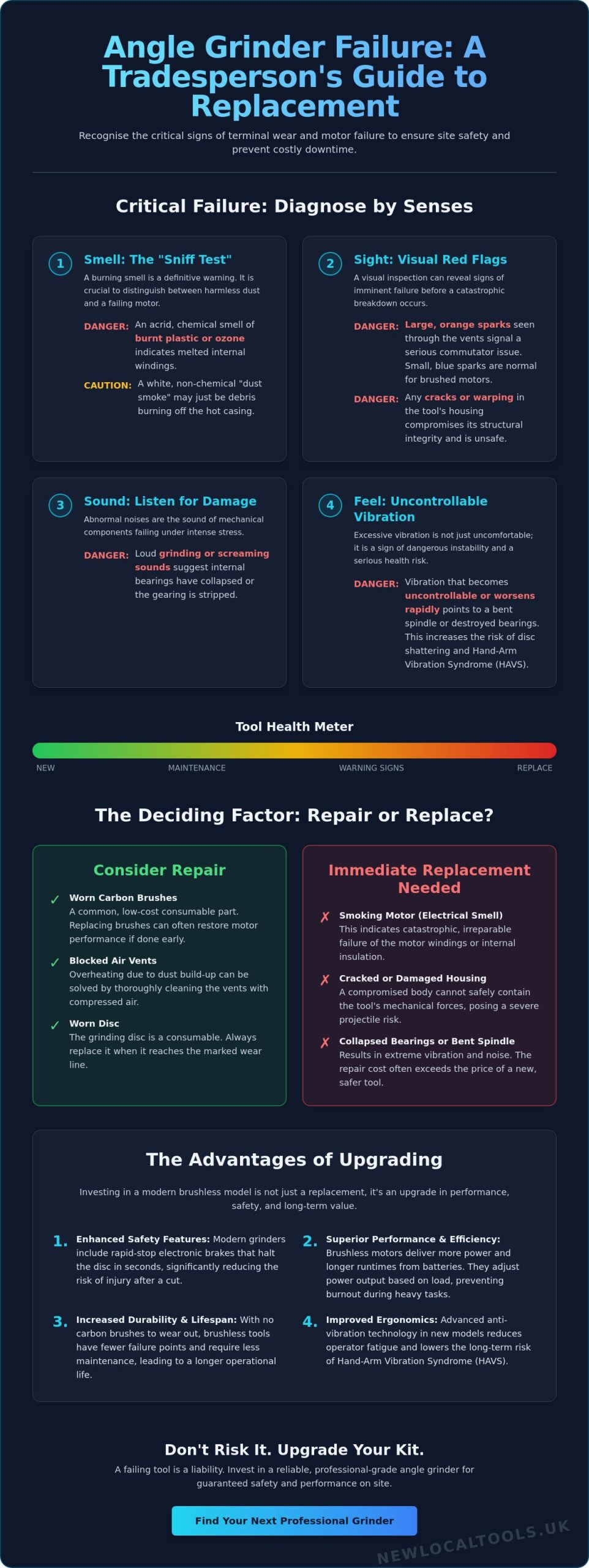
A smoking motor is the most urgent indicator that a tool has reached its limit. Whilst some performance issues can be managed with a fresh disc, internal motor failure is often terminal. Professional tradespeople must recognise these warnings to avoid unexpected downtime and site accidents. Knowing when to replace an angle grinder involves monitoring the motor’s behaviour under load and identifying smells that signal internal damage. If the tool begins to struggle with basic tasks, the cost of a replacement is always lower than the risk of a catastrophic failure.
Troubleshooting a Smoking Angle Grinder
Not all smoke indicates a total burnout. When cutting masonry or concrete, fine debris can enter the vents and burn against the hot motor casing. This "dust smoke" is usually white and lacks a strong chemical odour. Electrical smoke is far more serious. It typically carries the acrid scent of burnt plastic or ozone, suggesting that the internal windings have melted or a short circuit has occurred.
The "sniff test" is a practical way to diagnose the issue. If the tool emits a sharp, metallic smell, the stator is likely compromised. Continuing to use a tool in this state is dangerous. It can lead to a sudden fire or an electrical surge that damages your power supply or battery. If the motor begins to plume, stop work immediately and disconnect the power source. If the smell persists after the tool cools down, the internal insulation has likely failed beyond repair.
Mechanical Red Flags: Noise and Heat
Persistent sparking visible through the motor vents is another major concern. Whilst small, blue sparks are normal for brushed motors, large orange flashes indicate the commutator is damaged. This often coincides with a significant loss of torque. If the disc stalls under minimal pressure, the motor can no longer maintain the magnetic field efficiency required for professional work. This loss of power makes the tool unpredictable and difficult to control during precision cuts.
Replacing the Disc vs. Replacing the Tool
Performance drops often stem from the abrasive media rather than the motor itself. However, knowing when to replace an angle grinder requires a clear understanding of where the consumable ends and the machinery begins. If a professional notices a drop in cutting speed or a ragged finish, the first action is always to inspect the disc. A fresh accessory often restores the tool’s original efficiency, saving the cost of a full replacement. But if vibration persists even after fitting a premium replacement, the issue has moved into the tool’s hardware. Excessive spindle play or worn bearings are mechanical failures that no amount of new accessories can fix.
The "Wear Line" is a non-negotiable safety marker for any abrasive disc. Once the material erodes to this point, the structural integrity of the disc is compromised. Continuing beyond this line increases the risk of the disc shattering under the high RPMs typical of site work. When the disc is still within its limits but the tool body feels hot to the touch or vibrates uncontrollably, the internal components have likely reached terminal fatigue. These symptoms indicate that the tool’s life cycle is over and a new unit is necessary to maintain site safety.
| Tool/Component | Primary Use | When You Need It |
|---|---|---|
| Cutting Disc | Slicing metal or masonry | Reached wear line or visible chips |
| Grinding Disc | Surface prep and weld removal | Glazed surface or uneven wear |
| Motor Body | Housing the internal components | Smoke detected or acrid smell |
| Gear Head | Transferring power to the spindle | Excessive spindle play or screaming |
When a Repair is No Longer Cost-Effective
Professional repairs in the UK often involve high labour rates that quickly approach the price of a brand-new unit. When comparing parts and labour against the cost of a new DeWalt or Makita grinder, the investment in modern hardware usually wins. Worn bearings often cause a "cascading failure" where the resulting heat and vibration destroy a new set of carbon brushes or melt the motor windings within hours. This makes simple repairs a gamble rather than a long-term solution.
Safety compliance is another vital factor in the decision. Older models often lack the rapid-stop electronic brakes and anti-kickback clutches found on contemporary machines. These features are increasingly required by UK site managers to meet strict health and safety protocols. Sticking with a patched-up tool might save a few pounds today, but it risks non-compliance and site-wide safety. Determining when to replace an angle grinder is as much about meeting modern standards as it is about fixing a mechanical fault.
Maintenance Essentials and Consumables
Proactive maintenance is the most effective way to delay the moment you need to decide **when to replace an angle grinder. **Whilst these tools are built for rugged site conditions, fine dust from masonry or metal grinding settles deep within the motor housing. This buildup acts as an abrasive that strips insulation from motor windings and clogs cooling paths. Cleaning vents with compressed air after every shift prevents the overheating that leads to the terminal smoke discussed in previous sections. A clean motor runs cooler, maintains higher torque, and suffers less from the internal friction that causes premature bearing failure.
Carbon brushes are the primary wear point in brushed motors. These small components maintain the electrical connection between the power source and the spinning commutator. Once they wear down to less than 5mm, they can cause the heavy sparking and intermittent power delivery often mistaken for a total motor burnout. Regularly checking and replacing these brushes prevents permanent damage to the commutator, effectively doubling the tool’s operational life. Ignoring this simple task often turns a five-minute maintenance job into a full tool replacement.
| Item | Use | Notes |
|---|---|---|
| Slitting Discs | Thin metal cutting | Buy in packs of 10 for better value |
| Flap Discs | Sanding and finishing | Match the grit level to the required finish |
| Carbon Brushes | Restoring electrical contact | Replace when length is less than 5mm |
| Spanner Wrench | Changing discs safely | Keep a spare in the tool case |
Selecting the Right Accessories
Tool performance depends heavily on the quality and compatibility of the fitted accessories. Matching the disc RPM rating to the tool’s maximum speed is a non-negotiable safety step. If a disc is rated lower than the grinder’s output, it can shatter instantly upon activation. Using the incorrect bore size or an unbalanced disc creates the excessive vibration that destroys internal bearings and gear sets. This mechanical stress accelerates the wear on the spindle, eventually leading to the dangerous disc run-out mentioned earlier. Finding high-quality accessories at New Local Tools ensures that every component is engineered to handle professional-grade stress.
Upgrading to Professional Cordless Angle Grinders
Recognising when to replace an angle grinder often leads to a critical choice between patching up old tech or embracing modern cordless platforms . Whilst corded tools were once the only option for heavy-duty grinding, current battery technology now rivals mains power for most UK trade applications. Moving to a cordless system eliminates the trip hazards of trailing leads and provides the mobility required for complex site work in London and beyond. Finding the best deals on professional-grade replacements allows tradespeople to modernise their kit without overextending their budget.
Benefits of Brushless Motor Technology
The transition from brushed to brushless motors represents a significant leap in tool efficiency. Brushless motors use electronic controllers instead of physical carbon brushes to manage power delivery. This design offers several practical advantages for the professional user:
-
Increased Run-time: Without the friction of brushes, motors run cooler and extract more work from every battery charge.
-
Power-to-Weight Ratio: Brushless units are typically more compact and lighter, reducing user fatigue during long shifts.
-
Tool Intelligence: Modern electronics sense overloads and cut power instantly, preventing the motor burnout that often plagues older machines.
-
Lower Maintenance: The removal of carbon brushes eliminates a primary wear point, significantly reducing the long-term cost of ownership.
Safety Features in Modern Replacements
Modern replacements prioritise operator protection through advanced integrated systems. Electronic brakes can stop a spinning disc in under two seconds, a massive improvement over the long coast-down time of older models. Anti-kickback clutches detect if a disc jams in the material and shut down the motor immediately. This prevents the tool from twisting violently in the operator’s grip, reducing the risk of wrist injuries or loss of control.
Ergonomics also play a vital role in tool longevity and user health. Many new models feature vibration-dampening side handles and "dead-man" paddle triggers that ensure the tool stops if dropped. "One Battery " systems add further value, as a single high-capacity pack can power a grinder, a circular saw, and a combi drill. This modularity simplifies site logistics and reduces the need for multiple chargers. For those ready to upgrade, the New Local Tools Shop provides a comprehensive range of the latest professional cordless technology.
Secure Your Site Performance
Identifying **when to replace an angle grinder ** is a critical skill for any professional trader. Whilst routine maintenance like cleaning vents and replacing carbon brushes can extend a tool’s lifespan, terminal signs like acrid smoke or excessive spindle play are non-negotiable indicators that a machine is no longer safe. Sticking with a failing tool compromises work quality and risks serious site injury. Upgrading to modern brushless technology provides immediate benefits in power, safety, and reliability. Modern cordless platforms now offer the torque required for heavy-duty metal and masonry work without the hazards of trailing leads.
Upgrade the kit with professional angle grinders at New Local Tools. Keep the workshop running at peak efficiency and stay safe on every cut.
Frequently Asked Questions
Can a motor be replaced individually?
Replacing an angle grinder motor is technically possible but rarely advisable for professional tools due to the precision required for gear alignment. Improper installation often leads to excessive vibration and premature bearing failure. Most manufacturers do not provide motor assemblies as separate consumer parts for safety reasons. It is generally more efficient to invest in a new unit that meets current UK safety regulations rather than attempting a complex internal rebuild.
How is the source of vibration identified?
Identifying the source of vibration requires running the tool briefly without any accessory fitted. If the vibration persists whilst the spindle is bare, the internal bearings or the spindle itself are damaged. If the tool runs smoothly, the issue lies with an unbalanced or incorrectly fitted disc. Always ensure the disc RPM rating matches the tool speed. Persistent tool-side vibration is a clear sign that the internal hardware has reached terminal fatigue.
Is it cost-effective to repair older corded models?
How often do carbon brushes require inspection?
Carbon brushes require inspection every 50 to 100 hours of operational time or whenever performance drops. If the brushes are worn down to less than 5mm, they must be replaced to prevent permanent damage to the commutator. Regular checks are essential for maintaining electrical efficiency in brushed motors. For those using tools daily on-site, a monthly inspection routine helps identify when to replace an angle grinder or simply swap out a low-cost consumable part.



 153 Leytonstone Road, E15 1LH
 Log into your account


