
 153 Leytonstone Road, E15 1LH, London


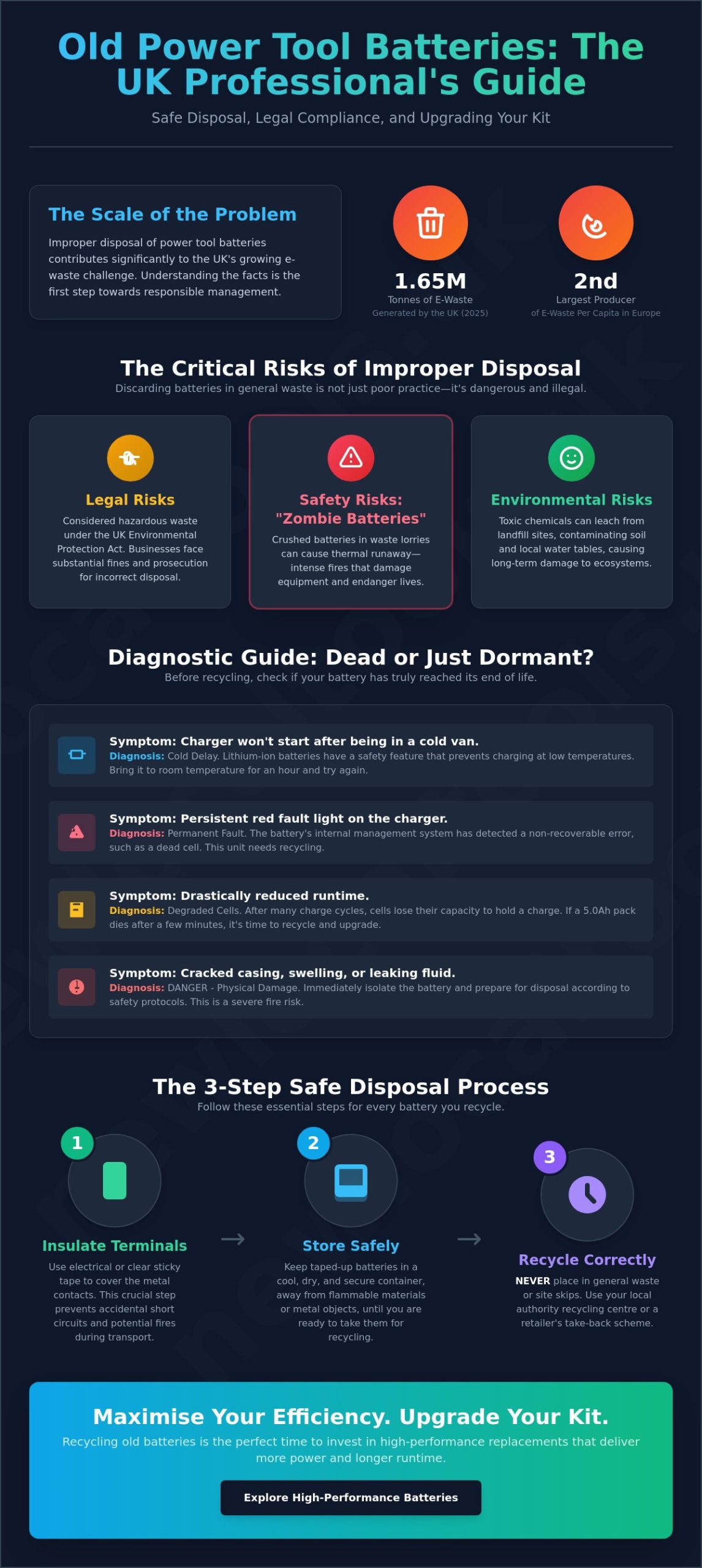
The UK generated 1.65 million tonnes of e-waste in 2025, positioning it as the second-largest producer per capita in Europe. For tradespeople, much of this waste consists of depleted cells cluttering vans and workshops. It is easy to agree that the risk of lithium-ion fires in waste collection vehicles makes proper disposal a priority. Knowing exactly what to do with old power tool batteries UK is vital for maintaining site safety and ensuring full legal compliance.
This professional guide details the most efficient methods for recycling high-capacity batteries. It covers diagnostic steps to identify dead cells, legal obligations for UK businesses, and safe handling protocols for damaged units. Following these steps ensures a seamless transition to more powerful, high-capacity cordless technology whilst keeping the workshop organised and safe.
Table of Contents
-
The Legal and Safety Risks of Improper Battery Disposal in the UK
-
Diagnostic Guide: Is Your Power Tool Battery Dead or Just Dormant?
-
Upgrading Your Kit: Choosing High-Performance Replacement Batteries
Key Takeaways
- Identify the critical safety risks of “zombie batteries” and ensure full compliance with UK hazardous waste regulations.
- Distinguish between a permanently failed battery and one experiencing a temporary software lockout or temperature-related performance drop.
- Discover what to do with old power tool batteries UK by utilising local authority recycling centres or retailer take-back schemes.
- Implement essential safety protocols for transport, including the insulation of terminals to prevent short circuits and fires.
- Evaluate high-performance replacements and shared battery platforms to maximise the efficiency and runtime of professional cordless power tools.Choosing High-Performance Replacement Batteries
The Legal and Safety Risks of Improper Battery Disposal in the UK
Tossing a depleted 18V pack into a standard site skip or domestic bin is more than just bad practice; it is a direct violation of the UK Environmental Protection Act. These units are classified as hazardous waste due to their complex chemical composition and high potential for environmental harm. When deciding what to do with old power tool batteries UK professionals must recognise that the "Crossed-out Wheelie Bin" symbol stamped on every casing is a legal instruction. It signifies that the product must be kept out of the general waste stream to prevent toxic chemicals from leaching into the soil at British landfill sites. This leakage can contaminate local water tables and damage ecosystems for decades.
Fire Hazards in Bin Lorries and Recycling Centres
The term "zombie batteries" refers to discarded power cells that "come back to life" by igniting when crushed. High-capacity professional batteries, such as 5.0Ah or 9.0Ah packs, contain significantly more energy than common household electronics. When a bin lorry’s hydraulic press or a recycling centre’s sorting machine crushes a battery, the internal separator fails. This triggers a thermal runaway event; a self-sustaining chemical fire that reaches extreme temperatures. These incidents put local authority staff at risk and cause millions of pounds in damage to UK infrastructure every year. Proper disposal is a critical safety protocol for every site manager and independent contractor.
UK Regulations for Battery Waste
Compliance is governed by the UK battery regulations, specifically the Waste Batteries and Accumulators Regulations 2009. These laws ensure that any business placing batteries on the market contributes to their eventual collection and recycling. For the professional end-user, the responsibility lies in ensuring hazardous waste is never mixed with general refuse. Fines for businesses disposing of hazardous waste incorrectly are substantial and can lead to prosecution. Understanding what to do with old power tool batteries UK ensures your operation remains compliant whilst helping the UK reach its ambitious 45% collection target for portable waste batteries. It’s a simple step that protects both the environment and your business reputation.
Diagnostic Guide: Is Your Power Tool Battery Dead or Just Dormant?
Before determining what to do with old power tool batteries UK, professionals should verify if a pack has reached a genuine end-of-life state or is simply experiencing a deep discharge lockout. Lithium-ion technology incorporates protective circuitry that prevents charging if the cell voltage drops below a specific safety threshold. If a battery is left in a depleted state for an extended period, the charger may fail to recognise the unit entirely. Whilst this lockout is a critical safety feature, it often leads to functional batteries being discarded prematurely. If a pack remains unresponsive after resting at room temperature, it is likely that the internal cells have degraded beyond a safe operating level.
UK weather conditions significantly influence battery performance and charging cycles. During colder months, batteries stored in unheated vehicles or site containers can experience a temporary drop in voltage that prevents the charger from initiating. Professional charging units usually indicate a cold delay, waiting for the internal temperature to stabilise before delivering power. Fuel gauges on high-performance cordless power tools provide essential diagnostic data. A single flashing LED typically signals a low charge, but specific error patterns, such as alternating flashes, often confirm a permanent hardware fault or high internal resistance.
Common Signs of Battery Failure
The most frequent indicator of failure is the persistent red fault light on a professional charger, signifying that the internal management system has detected a non-recoverable error. On the jobsite, a failing battery is characterised by a sharp reduction in runtime under load. If a 5.0Ah pack that previously provided half a day of service now fails after only a few minutes of use, the internal cells have likely lost their capacity to hold a charge. Physical indicators such as cracked casings, swelling, or the presence of leaking fluid necessitate immediate disposal according to official UK government guidance to prevent site fires.
The Battery Performance Comparison
Selecting the correct battery configuration is essential for balancing tool weight with the required runtime for specific tasks. High-capacity units offer longer operation but add weight that can increase user fatigue during overhead work. If a current battery setup no longer meets the demands of the trade, browsing the latest power tool accessories can help identify a more efficient power solution.
| Tool | Primary Use | When You Need It |
|---|---|---|
| 18V 2.0Ah Li-ion | Compact drills and impact drivers | Overhead work or tight spaces where reduced weight is critical. |
| 18V 5.0Ah Li-ion | General site work, circular saws , and grinders | Sustained power and balanced weight for a full day of trade use. |
| 54V/60V 9.0Ah+ | Heavy-duty demolition and large mitre saws | High-draw applications that require corded-equivalent performance. |
Where to Recycle Power Tool Batteries Across the UK
Locating a secure disposal point is the next logistical step for any tradesperson. Whilst many general advice sites suggest taking batteries to the local supermarket, these small collection tubes are rarely suitable for high-capacity 18V or 54V packs. Instead, professionals should look for specialist trade counters or local authority Household Waste Recycling Centres (HWRCs). These facilities are equipped to handle the specific hazards associated with professional-grade lithium-ion technology and have the capacity for larger volumes of waste. This is a critical piece of information for those wondering what to do with old power tool batteries UK.
The legal framework in the UK mandates that any retailer selling more than 32kg of portable batteries per year must provide a free take-back service. Given the weight of professional packs, almost every dedicated tool merchant meets this threshold. Unlike supermarket bins, trade-focused collection points are more likely to understand the handling requirements for heavy-duty cells from major brands like Makita , DeWalt , or Milwaukee . Many manufacturers also run dedicated return programmes through their authorised service centres to ensure materials are recovered efficiently.
Step-by-Step: Finding Your Nearest Collection Point
Retailer Obligations in the UK
Retailers have a clear legal duty. If a shop sells a significant volume of batteries, they are required by law to host a collection bin that is visible and accessible to the public. You don’t need to have purchased the original battery from that specific store to use their recycling bin. Online retailers also share this responsibility. They must either provide a take-back scheme via post or partner with a physical collection network to ensure their customers have a viable disposal route. This ensures that regardless of where you buy your cordless power tools , a recycling solution is always available nearby.
Safe Handling and Preparation for Battery Recycling
Safe transport is the final hurdle in the recycling process. Even a battery that no longer powers a tool often retains a residual electrical charge. If the exposed metal terminals come into contact with other batteries or conductive materials like loose screws or hand tools, a short circuit can occur. This creates an immediate fire risk in the back of a van or within a collection bin. Knowing what to do with old power tool batteries UK involves more than just finding a location; it requires a disciplined approach to workshop storage and transit preparation. Professionals should designate a specific, non-combustible container for spent cells to keep them separate from active stock and flammable site equipment.
Preparation Checklist for Recycling
Following these practical steps ensures every pack is site-safe before it leaves the workshop. A few minutes of preparation prevents significant hazards during the journey to the recycling centre. Use this checklist for every unit:
-
Insulate the terminals: Apply a small piece of non-conductive PVC electrical tape over every metal contact point. This simple action is the most effective way to prevent accidental discharge.
-
Bag individual units: Place each battery in its own clear plastic bag. This provides a secondary layer of insulation and prevents terminals from rubbing against each other.
-
Remove from tool bodies: Never dispose of a battery whilst it is still attached to a tool. Disconnect the pack to ensure the tool’s circuitry isn’t active during transport.
-
Check for debris: Ensure terminals are free from metal shavings or dust before taping.
This systematic approach ensures that hazardous waste is handled with the same professional standard as live equipment. It protects the tradesperson, the public, and the waste management staff who handle the materials later in the chain.
Managing Damaged or Leaking Batteries
Damaged batteries require immediate and specialised attention. If a lithium-ion pack appears swollen, "puffed," or shows signs of a cracked casing, it is unstable. In extreme cases, a failing battery might hiss, emit a pungent chemical smell, or begin to smoke. If this occurs on-site, the battery should be moved to a clear, outdoor area away from flammable materials. Use a bucket of dry sand or a dedicated fire-rated charging bag for temporary containment. These units must never be placed in standard recycling bins or sent through the UK postal system. Most local authority HWRCs have specific protocols for "damaged" lithium-ion cells; always alert the staff upon arrival so they can guide the unit to a reinforced containment area.
Maintain site efficiency by replacing failed units with high-performance alternatives. Restock the workshop with reliable power solutions by browsing the full range of professional power tool accessories available online.
Upgrading Your Kit: Choosing High-Performance Replacement Batteries
Once a professional has decided what to do with old power tool batteries UK, the focus shifts to selecting high-performance replacements that maximise site efficiency. Modern cordless platforms have evolved significantly. Moving to higher Amp-hour (Ah) ratings, such as 5.0Ah or 8.0Ah, provides the sustained power needed for demanding tasks like continuous masonry drilling or heavy timber cutting. Whilst higher Ah batteries are slightly heavier, the increased runtime reduces downtime by minimising trips to the charging station. This transition ensures that the workshop remains productive whilst phasing out older, less efficient technology.
Compatibility is a major advantage for tradespeople using established brands. Most new lithium-ion packs are backwards compatible with older 18V tool bodies, allowing for a cost-effective performance boost without replacing the entire kit. It’s vital to stick with genuine manufacturer batteries. Third-party alternatives often lack the sophisticated thermal management and communication chips found in original equipment. Using genuine packs prevents overheating and ensures the tool’s electronic protection systems function correctly. Professionals should prioritise reliability to avoid the safety risks associated with sub-standard cells.
Selecting the Right Replacement
Older NiCd or NiMH technologies are now obsolete in professional environments. Lithium-ion is the current standard, offering a higher energy density and no "memory effect," meaning they can be charged at any time without degrading the cells. For those running multiple tools, investing in multi-buy battery deals is the most efficient way to maintain a rolling charge cycle on-site. Professionals can find a wide range of professional power tool accessories to complement their upgraded power solutions and keep their kit in peak condition.
Essential Accessories and Maintenance
Proper storage prevents the physical damage that eventually leads back to the recycling centre. Using battery terminal covers keeps contacts free from conductive dust and moisture, whilst wall mounts ensure packs are organised and easily accessible in the van or workshop. Investing in a smart charger is also essential for kit longevity. These units use active cooling and microprocessors to monitor individual cell health during the cycle, which significantly extends the functional lifespan of the investment. Keeping a clean, organised battery station is a hallmark of a professional trade setup.
| Item | Use | Notes |
|---|---|---|
| Battery Terminal Covers | Protection | Prevents short circuits during transport in tool bags. |
| Wall Mount Brackets | Organisation | Secures batteries in the van or workshop to prevent drops. |
| Fast Smart Charger | Maintenance | Optimises charging cycles with active cell cooling. |
| Heavy-Duty Storage Case | Transport | Protects high-capacity packs from site impacts and moisture. |
Secure Your Site and Upgrade Your Power
Properly managing depleted lithium-ion packs is a critical safety protocol for every professional tradesperson. By utilising local authority recycling centres and following strict terminal insulation procedures, users eliminate the risk of "zombie battery" fires whilst remaining fully compliant with environmental regulations. Understanding exactly what to do with old power tool batteries UK ensures that hazardous waste is handled responsibly and clears space for more efficient, high-capacity technology.
When a battery reaches the end of its functional life, it’s essential to replace it with genuine manufacturer cells to guarantee site safety and tool longevity. New Local Tools serves as an official stockist for DeWalt , Makita , and Milwaukee , providing the high-performance solutions required for intensive trade applications. Upgrade your power tool batteries at New Local Tools to maintain peak productivity on every job. Transitioning to the latest 18V and 54V platforms ensures the workshop remains ready for any challenge.
Frequently Asked Questions
Can I put power tool batteries in my household recycling bin in the UK?
No, power tool batteries must never be placed in household recycling or general waste bins. These units pose a significant fire risk when compressed by the hydraulic systems in bin lorries. Crushing a lithium-ion pack triggers thermal runaway, which leads to intense fires that are difficult for emergency services to extinguish. Always use a designated battery collection point to ensure site safety and environmental compliance.
Do I need to pay to recycle my old professional batteries at a UK tip?
No, recycling old power tool batteries at local authority Household Waste Recycling Centres (HWRCs) is a free service for UK residents. Whilst businesses may have specific commercial waste requirements, individual tradespeople can typically dispose of portable batteries without a fee. This ensures there’s no financial barrier when deciding what to do with old power tool batteries UK whilst clearing out the workshop or van.
Will a supermarket battery bin accept a large 54V Flexvolt battery?
Supermarket battery bins are generally not designed for large, heavy-duty professional batteries like a 54V Flexvolt pack. These collection tubes are intended for small household cells like AA or AAA batteries. High-capacity professional batteries are often too large for the openings and can exceed the weight limits of the units. It is more efficient to use a dedicated trade counter collection point or a local authority recycling centre when considering what to do with old power tool batteries UK.
How should I store a damaged battery before I can get to a recycling centre?
A damaged or swollen battery should be stored outdoors in a non-combustible container, such as a metal bucket filled with dry sand. Keep the unit away from flammable materials and out of direct sunlight to prevent overheating. If the casing is cracked or leaking, use a fire-rated charging bag for temporary containment. This prevents a potential ignition from spreading whilst you arrange for safe transport to a specialist disposal facility.
What happens to the materials inside my battery once it is recycled?
Recycled batteries are shredded in a controlled environment to safely recover valuable raw materials. The process extracts critical metals such as lithium, cobalt, nickel, and copper, which are then purified for reuse in manufacturing new battery cells. This circular approach reduces the need for destructive mining and helps the UK meet its annual collection targets. Recycling ensures that these high-value components remain in the professional tool supply chain.
Buy power tool batteries at the best prices from New Local Tools!




 153 Leytonstone Road, E15 1LH
 Log into your account


