
 153 Leytonstone Road, E15 1LH, London






A standard chrome vanadium socket is a liability when paired with a modern high-torque impact wrench. Many professionals have experienced the sharp crack of a failing tool or the irritation of a rounded bolt head caused by a loose fit. Finding the best impact socket set for mechanics is critical as torque demands in the automotive sector now frequently exceed 600 Nm.
This guide identifies the essential technical features and professional-grade materials — specifically Chrome Molybdenum (Cr-Mo) steel — necessary for long-term durability. It covers ASME B107.110 standards and compares the most effective socket configurations for professional use.
Key Takeaways
- Understand why Chrome Molybdenum (Cr-Mo) is the essential material standard for absorbing high-torque shock without fracturing.
- Learn how to identify the best impact socket set for mechanics by evaluating drive sizes and professional-grade configurations.
- Discover how high-visibility laser etching and thin-wall designs improve efficiency in dark or narrow engine bays.
- Explore the differences between 3/8-inch and 1/2-inch drive sets to match your specific mechanical tasks.
- Gain insights into the latest 2026 industry standards to ensure your tool investment provides long-term workshop reliability.
Table of Contents
- What is an Impact Socket and Why Do Mechanics Need Them?
- Material Science: Chrome Vanadium vs Chrome Molybdenum
- Selecting the Right Configuration and Drive Size
- Specific Features to Look for in a Professional Set
- Professional Impact Solutions at New Local Tools
What is an Impact Socket and Why Do Mechanics Need Them?
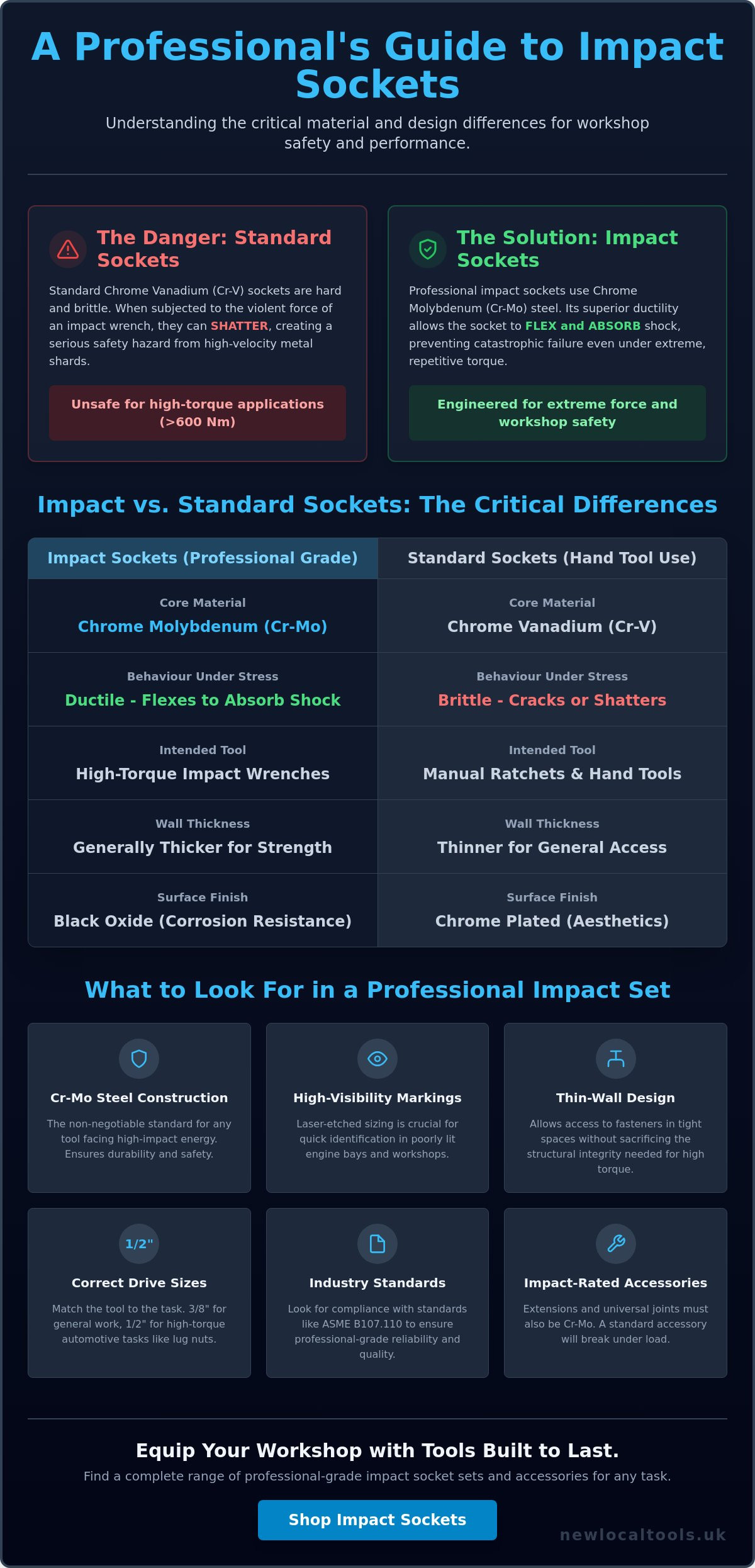
An impact socket is a specialised version of the traditional Socket wrench designed specifically to withstand the violent, repetitive rotational strikes of a power tool. Unlike hand tools, these are engineered for use with cordless impact wrenches and pneumatic drivers that deliver high-frequency hammering blows. Their primary function is to absorb this sudden torque without cracking or shattering, ensuring the tool remains intact under extreme stress. Choosing the best impact socket set for mechanics involves looking beyond the surface to find tools that prioritise this structural integrity and long-term workshop reliability.
Safety is the most compelling reason to use impact-rated gear. Standard chrome sockets are made from harder, more brittle steel. When subjected to rapid-fire impacts of a 1/2-inch power driver, they fail — shattering into high-velocity metal shards. Impact sockets are manufactured to be more ductile, allowing them to deform slightly rather than snap. The distinctive black oxide finish provides corrosion resistance in damp workshop environments and allows instant visual identification to prevent accidental use of non-rated tools.
How and When Impact Sockets Are Used
Mechanics reach for these tools when dealing with high-torque fasteners that a manual ratchet cannot budge — seized lug nuts, stubborn suspension bolts, and rusted chassis components. In high-volume assembly environments, impact sockets ensure speed and torque consistency across hundreds of repetitions.
Impact Sockets vs Standard Sockets
The most visible difference is wall thickness. Impact sockets often have thicker walls to provide more mass and strength, though this can limit accessibility in tight recesses. Professional sets balance this by using superior materials that allow for thinner walls without sacrificing safety. It’s also vital to use impact-rated accessories. Extensions and universal joints must be rated for power use; using a standard extension with an impact socket creates a weak point that can snap under load.
| Tool | Primary Use | When You Need It |
|---|---|---|
| Impact Socket | High-torque power tool applications | Removing seized lug nuts or suspension bolts |
| Standard Socket | Manual ratcheting and light assembly | General maintenance where space is restricted |
It’s also vital to use impact-rated accessories. Extensions and universal joints must be rated for power use — a standard extension with an impact socket creates a weak point that can snap under load.
Essential Impact Accessories
| Item | Use | Notes |
|---|---|---|
| Impact Extension Bar | Reaching deep-set fasteners | Must be Cr-Mo rated to match socket strength |
| Impact Universal Joint | Accessing bolts at difficult angles | Check for ball-lock retention for safety |
Material Science: Chrome Vanadium vs Chrome Molybdenum
Most standard sockets in DIY kits are made from Chrome Vanadium (Cr-V). This alloy is excellent for hand tools because it is hard and resists bending. However, that hardness makes it brittle. When hit by a high-torque power tool, Cr-V doesn’t flex — it shatters, sending metal fragments across the workshop.
The difference between Chrome Vanadium (Cr-V) and Chrome Molybdenum (Cr-Mo) is also seen in how they handle wear. Cr-Mo is specifically heat-treated to be slightly softer than Cr-V, which sounds counterintuitive. This specific level of hardness allows the socket walls to withstand the vibration of impact without fatiguing. Whilst the price of alloy steel fluctuates by 12% to 18% annually, investing in quality Cr-Mo remains the most cost-effective choice for long-term professional use.
Identifying Quality Metallurgy
Always look for forged construction — forging compresses the metal and aligns the grain, creating a far denser tool than casting. A high-quality set will also feature a black phosphate finish. Unlike paint, this coating is porous and holds onto oil, providing superior protection against damp workshop conditions.
| Material | Primary Use | When You Need It |
|---|---|---|
| Chrome Vanadium (Cr-V) | Manual ratchets and hand wrenches | General low-torque assembly and DIY tasks |
| Chrome Molybdenum (Cr-Mo) | Cordless and pneumatic impact wrenches | Heavy-duty removal of rusted or high-torque bolts |
Selecting the Right Configuration and Drive Size
For most UK automotive tasks, the 1/2-inch drive is the industry workhorse. It provides the necessary surface area to transfer high torque for wheel nuts and heavy suspension components. The 3/8-inch drive is essential for engine bay work — its smaller profile reaches fasteners on alternators, water pumps, and timing covers where a larger tool cannot fit.
Fastener standards in the UK are almost exclusively metric for modern vehicles. A comprehensive kit should range from 8mm to 32mm for full coverage of standard passenger cars and light commercial vehicles.
Summary Comparison of Impact Socket Types
| Tool | Primary Use | When You Need It |
|---|---|---|
| 1/2-inch Deep Metric Set | Wheel nuts and recessed bolts | Daily automotive servicing |
| 3/8-inch Shallow Set | Tight engine compartments | Alternator or water pump replacement |
| 3/4-inch Heavy Duty Set | Commercial vehicles and plant | HGV or agricultural repair |
| Impact Universal Joint | Angled access | Obstructed fasteners |
6-Point vs 12-Point Geometry
For impact applications, 6-point geometry is the only professional choice. 12-point sockets have thinner walls and are prone to slipping and rounding off fasteners under high load. A 6-point design provides maximum contact with the flats of the bolt head. Modern professional sets use off-corner loading technology — the socket grips the flat sides of the fastener rather than the corners, significantly reducing rounding even on rusted or soft-metal bolts.
Specific Features to Look for in a Professional Set
Thin-wall impact sockets are engineered to fit tight spaces whilst maintaining structural integrity for high-torque applications. This requires high-quality Cr-Mo steel to ensure thinner walls don’t fail under the stress of a 1,000 Nm cordless wrench .
Pin holes and O-ring grooves provide a mechanical lock between the socket and the tool’s drive square — essential for overhead work or industrial tasks where a dropped socket could cause injury.
Restock Table for Consumables and Accessories
| Item | Use | Notes |
|---|---|---|
| Impact O-Rings | Securing socket to the drive square | Replace when cracked or stretched |
| Retaining Pins | Mechanical lock for high-vibration use | Essential for overhead work safety |
| Impact Extensions | Reaching recessed fasteners | Ensure extension is also impact-rated |
| Thread Lubricant | Preventing galling on high-torque fasteners | Use sparingly to maintain torque accuracy |
Storage and Organisation Solutions
A robust blow-moulded carry case protects sockets from moisture during transport. For mobile mechanics, socket rails provide a compact alternative. Colour-coded systems differentiate between metric and imperial sizes at a glance.
Professional Impact Solutions at New Local Tools
New Local Tools stocks a range of professional impact socket sets from trusted brands — covering 1/4-inch, 3/8-inch, and 1/2-inch drive configurations for automotive, mechanical, and site work.
For 1/4-inch drive: the Blue Spot 01488 1/4″ Hex Socket Bit Set — 11 Piece covers standard bit applications, and the Blue Spot 01622 3/8″ M4-M14 Impact Spline Bit Sockets — 9 Pieces handles spline fasteners found in modern European vehicles.
For 3/8-inch drive: the Blue Spot 01624 3/8″ Impact Torx Bit Sockets — 11 Pieces is ideal for Torx-head fasteners common in German and Scandinavian vehicles. The Milwaukee 4932480453 1/4″ Shockwave Impact Socket Set — 12 Piece delivers Milwaukee’s Shockwave Cr-Mo construction for extreme durability.
For 1/2-inch drive: the Vaunt X1446001 X 3/8″ Deep Impact Socket Set — 8 Piece provides deep reach for recessed bolts and wheel studs. The [Wera 05003883001 1/4″ Belt Zyklop Socket Set — 9 Piece brings German precision engineering to the 1/4-inch drive format — favoured by mechanics who prioritise accuracy and ergonomics.
Browse all impact socket sets at New Local Tools →
Equip Your Workshop for Maximum Efficiency
New Local Tools stocks professional impact socket sets from Blue Spot, Milwaukee, Vaunt, Makita, and Wera with free UK delivery on orders over £100.
Browse all impact socket sets at New Local Tools →
Frequently Asked Questions
Can I use standard chrome sockets with an impact wrench?
No, standard chrome sockets shouldn’t be used with an impact wrench because they’re too brittle. Chrome vanadium steel is designed for manual ratchets and can’t handle the rapid hammering of a power tool. It’s likely to shatter under load, creating high-velocity shards that cause serious injury. Always stick to the best impact socket set for mechanics, which uses ductile Chrome Molybdenum to absorb these violent shocks safely.
What is the difference between deep and shallow impact sockets?
Shallow sockets provide the most direct torque transfer and are ideal for tight engine bays. Their shorter profile suffers less energy loss during the impact cycle. Deep sockets are necessary for reaching nuts on long threaded studs or recessed fasteners where a shallow tool won’t reach. Most professional workshops carry both configurations to ensure they’re prepared for any mechanical scenario without compromising on speed or safety.
Why are impact sockets usually black instead of shiny chrome?
The matte black finish is a chemical coating, usually black phosphate, that resists corrosion whilst preventing the surface from flaking. Shiny chrome plating is too brittle for impact work; the constant vibration would cause the chrome to chip and peel. This black coating also acts as a visual safety marker. It helps mechanics quickly distinguish their impact-rated tools from standard hand sockets, preventing dangerous mistakes during a busy shift.
What drive size is best for a general automotive mechanic?
A 1/2-inch drive is the most versatile choice for a general automotive mechanic in the UK. It’s the industry standard for wheel nuts, suspension components, and heavy chassis work. This size provides enough mass to transfer torque effectively without being too bulky. For lighter work in confined spaces, such as alternator or water pump replacements, adding a 3/8-inch set is the next logical step for a professional kit.


 153 Leytonstone Road, E15 1LH
 Log into your account


