
 153 Leytonstone Road, E15 1LH, London






Why do the toughest safety gloves on the market often feel like wearing heavy oven mitts when trying to operate a precision impact driver? Finding the best work gloves for construction site UK projects requires more than just picking the thickest pair available. Most tradespeople recognise the frustration of gear that wears through in days or causes sweaty, uncomfortable hands during a ten-hour shift. It’s a constant struggle to balance heavy-duty protection with the dexterity needed for technical tool work.
This guide explains how to select the correct EN388-rated work gloves to balance site safety with maximum tool dexterity. It covers the technical requirements of BS EN 388:2016+A1:2018 and the mandatory UKCA marking for professional PPE. Readers will learn to match specific coatings to trade tasks to ensure gear lasts for weeks instead of days.
Key Takeaways
- Learn how to decode the EN388:2016+A1:2018 ratings to ensure every pair meets current UKCA safety standards for mechanical risks.
- Identify the best work gloves for construction site UK projects by matching specific material coatings to the primary hazards of your trade.
- Understand the trade-off between cut resistance and fingerfeel to maintain precision whilst operating high-torque cordless power tools.
- Discover the “Trigger Test” method to verify that site gloves don’t compromise tool safety switches or trigger sensitivity.
- Recognise the critical signs of glove failure to manage PPE restocking and maintain high hygiene standards on busy sites.
Table of Contents
- Understanding EN388 Safety Ratings for UK Construction Sites
- Task-Specific Selection: Matching Gloves to Trade Requirements
- Material and Coating Analysis: Nitrile, Latex, and Polyurethane
- Operating Power Tools Whilst Wearing Site Gloves
- PPE Management: Restocking and Maintaining Construction Gloves
Understanding EN388 Safety Ratings for UK Construction Sites
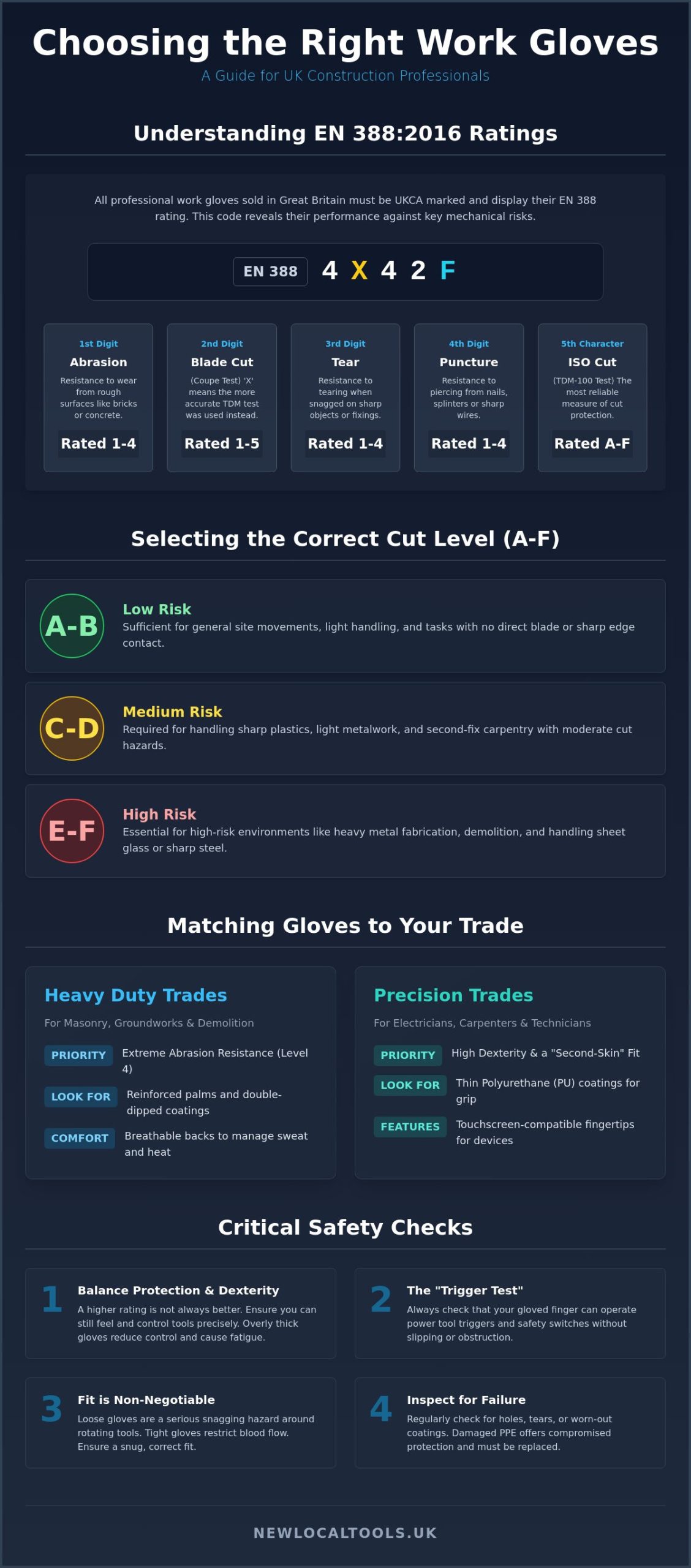
Selecting the best work gloves for construction site UK projects isn’t about guesswork; it’s about understanding the technical specifications printed on the back of the hand. Every professional pair must comply with BS EN 388:2016+A1:2018, a standard that protects workers against mechanical risks like abrasions and punctures. Since January 2023, all new gloves sold in Great Britain must also feature the UKCA marking to prove they meet these rigorous safety requirements. Employers have a legal duty under the Personal Protective Equipment at Work Regulations 1992 to provide this gear free of charge to both staff and casual “limb (b)” workers.
The hammer icon on a glove is followed by a four-digit code and a letter. These digits represent Abrasion, Cut, Tear, and Puncture (ACTP) resistance. Abrasion is measured by how many cycles the material survives against sandpaper, which is essential for masonry workers. The second digit represents the traditional “Coupe” cut test, though this is often replaced by the more accurate TDM-100 test. Understanding these cut-resistant glove standards is vital for anyone handling sharp steel or glass. Tear and puncture ratings indicate how well the glove resists snags on demolition sites or sharp metal offcuts.
The ACTP Rating System Deciphered
Each digit in the code provides a specific performance level. A higher number generally indicates better protection, but it can also lead to a stiffer glove. Professionals should look for a balance that suits their specific daily tasks.
- Abrasion (1-4): Higher numbers mean longer life when handling abrasive blocks or timber.
- Blade Cut (1-5): The old Coupe test; if the blade dulls during testing, the TDM test (A-F) takes priority.
- Tear (1-4): High tear resistance prevents the glove from falling apart under heavy mechanical strain.
- Puncture (1-4): Crucial for protecting against splinters, nails, and wire mesh.
Selecting the Correct Cut Level
A common mistake is assuming a higher rating is always superior. Thick, high-protection gloves often sacrifice the fingerfeel required for delicate tasks. For general site movements and light handling, Level A or B is usually sufficient. Tasks involving sharp plastics or light metalwork require Level C or D. High-risk environments such as heavy metal fabrication or demolition necessitate Level E or F. Professionals must always refer to their site-specific risk assessment before choosing a cut level.
Task-Specific Selection: Matching Gloves to Trade Requirements
The search for the best work gloves for construction site UK professionals often ends in a compromise. High-level cut protection usually results in a loss of dexterity; whilst thin, flexible gloves offer little protection against heavy abrasion. Identifying the “Primary Hazard” of a role is the first step in effective selection. For a steel fixer, the hazard is sharp edges. For a labourer, it is repetitive friction. Under the HSE PPE at Work Regulations, employers must ensure that PPE is suitable for the task, meaning a generic “builders glove” is rarely sufficient for every role on a modern site.
Fit is equally critical. Loose-fitting gloves are a major snagging hazard when using rotating power tools like angle grinders or circular saws. A glove that is too large can be pulled into the spindle. Conversely, a glove that is too tight causes hand fatigue and restricts blood flow during long shifts.
Gloves for Heavy Masonry and Groundworks
Masonry work demands extreme abrasion resistance. Concrete blocks and bricks act like heavy-duty sandpaper on glove palms. Professionals should prioritise a high EN388 abrasion rating (Level 4) over maximum cut protection. Reinforced palms and double-dipped coatings extend the life of the gear significantly. Because groundworks are physically demanding, choosing a glove with a breathable back helps manage sweat and prevents skin irritation.
High-Dexterity Options for Electricians and Carpenters
Carpenters and electricians require a second-skin fit to maintain efficiency. Handling small screws, wire stripping, or using site management apps on tablets requires fine-motor control. Polyurethane (PU) coatings are favoured here because they provide excellent grip without adding bulk. Many modern designs feature touchscreen-compatible fingertips, allowing tradespeople to check digital blueprints without removing their gloves.
| Tool / Task | Primary Use | When You Need It |
|---|---|---|
| Bricklaying | Handling abrasive materials | Moving blocks, bricks, or stone |
| First Fix Carpentry | Handling timber and fasteners | Framing, roofing, and joist work |
| Electrical Installation | Precision wiring and small parts | Pulling cables or terminating circuits |
| Demolition | Impact and sharp edge protection | Clearing debris and handling scrap metal |
Material and Coating Analysis: Nitrile, Latex, and Polyurethane
Selecting the best work gloves for construction site UK projects involves a choice between various synthetic and natural coatings. Each material reacts differently to the environment.
Nitrile foam is widely considered the best all-rounder. It provides a reliable grip in oily or slightly damp conditions by wicking moisture away from the surface. In contrast, latex coatings offer maximum grip for dry handling but perform poorly when exposed to oils. Polyurethane (PU) coatings provide what many tradespeople describe as invisible protection — incredibly thin, allowing for the highest levels of dexterity whilst maintaining a barrier against abrasions. For tasks requiring extreme durability, traditional leather rigger gloves still outperform modern synthetics in resistance to heat and heavy friction.
Performance in Wet and Oily Conditions
Sandy nitrile coatings feature a textured finish that creates a micro-suction effect, allowing for a secure hold on oily metal or wet scaffolding tubes. Fully coated gloves keep hands dry in heavy rain but can lead to excessive sweating. Water-resistant palm dips offer a compromise, protecting the contact area whilst allowing the back of the hand to breathe.
Breathability and Skin Health
Long shifts in non-breathable gear can lead to skin irritation and contact dermatitis. According to the HSE Personal Protective Equipment at Work Regulations, employers must provide PPE that is comfortable and doesn’t create additional health risks. Professionals should look for OEKO-TEX certification, which guarantees the material is free from harmful substances that cause allergic reactions. Vented backs are essential for high-exertion tasks, as they allow heat to escape. Proper glove rotation and regular hand hygiene are the most effective ways to prevent moisture-related skin issues on site. Choosing high-quality synthetic liners helps move sweat away from the skin, keeping hands dry and healthy throughout the working day.
Operating Power Tools Whilst Wearing Site Gloves
Power tool ergonomics are designed for bare-hand precision, yet site safety protocols demand constant hand protection. The “Trigger Test” is a practical onsite check: if the glove material bunches and prevents the safety switch from engaging or disengaging instantly, it’s a hazard. This is particularly relevant when operating high-performance DeWalt or Makita cordless tools, where variable speed triggers require subtle finger pressure to manage torque levels accurately.
Trigger Control and Safety Switches
Excessive bulk in the finger stalls is a common cause of mistakes during technical tasks. When using precision impact drivers, a thick seam at the fingertip can lead to accidental trigger pulls or difficulty feeling the bit engagement. Loose fabric can be caught in rotating chucks or circular saw blades, leading to serious injury. A second-skin fit is essential for anyone moving between manual handling and power tool operation.
Impact and Vibration Protection
Heavy-duty tasks involving SDS drills or breakers require protection beyond simple abrasion resistance. Impact-rated gloves feature TPR (Thermoplastic Rubber) zones to shield knuckles from glancing blows during heavy demolition. For those working with high-torque tools over long periods, checking for the ISO 10819 standard provides additional protection against Hand-Arm Vibration Syndrome (HAVS).
PPE Management: Restocking and Maintaining Construction Gloves
Managing the lifecycle of protective gear is essential for maintaining site safety and operational efficiency. A glove is a technical tool that wears down over time. Once the protective coating thins or the liner tears, the EN388 safety ratings no longer apply. Implementing a structured restocking schedule prevents the common habit of making do with worn-out equipment.
Hygiene is often overlooked in PPE management but remains vital for worker comfort. Modern synthetic gloves can often be washed in a standard machine at low temperatures — this removes salt from sweat and abrasive dust, which extends the life of the liner. However, if a glove becomes contaminated with hazardous chemicals or heavy oils, disposal is the only safe route.
When to Replace Your Gloves
The “Daylight Test” is the most reliable onsite method: if daylight is visible through the palm material or finger seams, the glove has failed. Oil-saturated gloves must be discarded immediately. Whilst budget disposables seem cheaper initially, mid-tier gloves often prove more cost-efficient because they survive multiple weeks of abrasive work rather than a few days.
Bulk Procurement and Storage
| Item | Use | Notes |
|---|---|---|
| Nitrile Foam Gloves | General site handling | Best for wet and oily grip; replace if coating peels. |
| PU Coated Gloves | Precision electrical and joinery | Maximum dexterity; check fingertips for wear daily. |
| Cut Level E/F Gloves | Handling steel and glass | Critical for high-risk tasks; discard if liner is nicked. |
| Thermal Work Gloves | Winter site work | Essential for cold weather; ensure internal lining stays dry. |
New Local Tools stocks professional work gloves for every trade and hazard level.
For cut protection: Milwaukee 4932492915 Hi-Vis Cut Level A and Milwaukee 4932478161 Cut A Gloves — Pack of 12.
For precision work: Kamtec STM High-Dexterity Gloves and Scan SCAGLOPUS Black PU Dipped Gloves — 5 Pairs.
For general handling and wet conditions: Kamtec PORTLAND Everyday PU Coated Glove and Kamtec CGXL10W HandMax Waterproof Gloves.
For disposable protection: Mercator Nitrylex Black — Box 100 and Mercator Nitrylex Classic Blue — Box 100.
Browse all work gloves in New Local Tools.
Frequently Asked Questions
What is the best glove for handling wet bricks and blocks?
Sandy nitrile-coated gloves are the most effective choice for handling wet bricks and blocks. The textured “sandy” finish creates a micro-suction effect that maintains a secure grip on slippery, abrasive surfaces. For these tasks, professionals should prioritise a Level 4 abrasion rating under EN 388 to ensure the material survives constant friction. Avoid standard latex in oily conditions, but for pure wet masonry work, a high-quality latex dip also provides excellent traction.
Can I wash my work gloves to make them last longer?
Are touchscreen-compatible gloves durable enough for construction?
Touchscreen-compatible gloves are now built with the same industrial durability as standard professional gear. Manufacturers integrate conductive metal fibres or specific carbon-infused coatings into the fingertips, allowing site managers to operate tablets without removing protection. Whilst these gloves are often thinner to improve dexterity, they still carry high EN 388 ratings for abrasion and tear resistance. They are perfectly suitable for tradespeople who need to check digital blueprints or site apps frequently.
What is the difference between a cut level 3 and a cut level C?
The difference lies in the testing method used for the EN 388 standard. Level 3 refers to the older “Coupe” test, which measures cut resistance on a scale of 1 to 5. Level C refers to the modern TDM-100 test, which uses a sliding blade and is rated from A to F. Level C is generally considered more accurate for high-risk tasks involving sharp steel or glass, as it better simulates real-world site accidents.
How do I find the right size work glove for my hand?
Finding the correct size involves measuring the circumference of the palm at its widest point, usually just below the knuckles, excluding the thumb. Most professional brands follow a standard numbering system where a 9-inch circumference corresponds to a Large (Size 9). A snug, “second-skin” fit is vital for safety; loose material is a significant snagging hazard when operating rotating power tools. Always check the specific manufacturer’s size guide before purchasing bulk site supplies.
Do I need different gloves for summer and winter on site?
Seasonal changes definitely require different glove specifications to maintain site safety. Summer tasks demand gloves with vented backs to prevent sweat build-up and skin irritation. Conversely, winter work requires thermal-lined gloves certified under the EN 511 standard to protect against contact cold. Using the best work gloves for construction site UK winters also involves choosing water-resistant coatings to keep the inner lining dry, as damp material quickly leads to heat loss and reduced grip.




 153 Leytonstone Road, E15 1LH
 Log into your account


